
eSIM Routers
eSIM routers bring remote SIM provisioning into cellular gateways and industrial routers, but the deployment model depends heavily on the router firmware and management platform. An eSIM router is useful when it lets you manage profiles without visiting the site. The router must still have a reliable management path, sensible fallback behaviour, and the right antenna and network setup. Understanding the eUICC chip inside the router is key to understanding what the eSIM capability actually gives you.
Device types: routers, gateways, modems and dongles
Cellular connectivity hardware covers a wide range of form factors. The right choice depends on the deployment environment, the number of downstream devices, and whether remote management is a requirement.
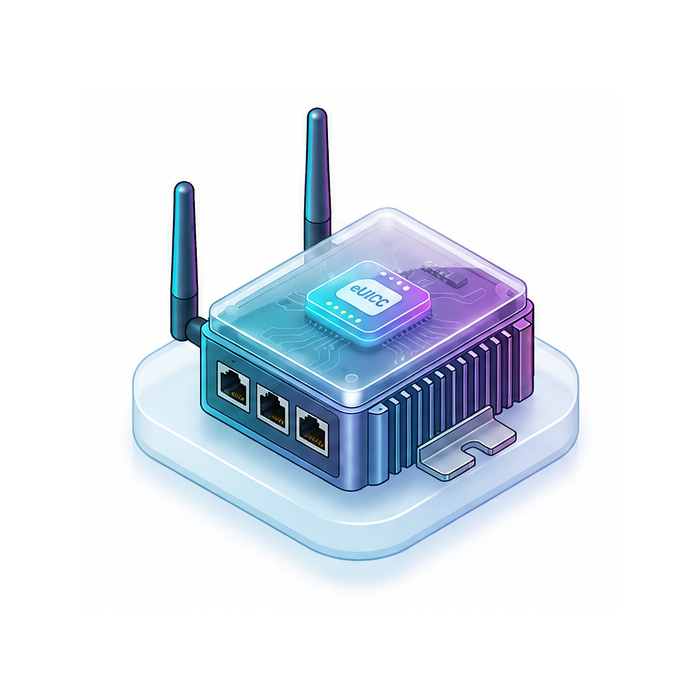
Industrial routers
DIN-rail or panel-mount units for factory, utility, and transport deployments. Multiple WAN inputs, I/O ports, VPN, firewalling. Designed for -40/+70°C operation.
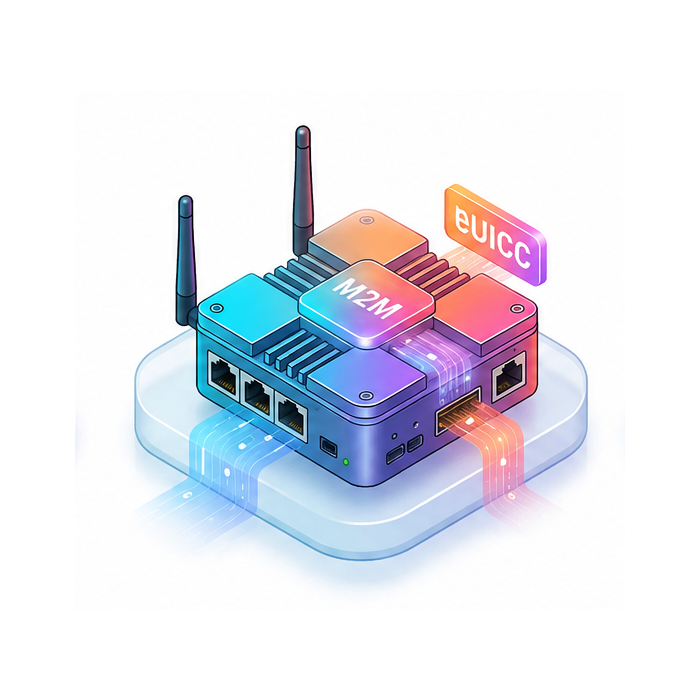
Cellular gateways
Simpler than full routers. One WAN, Ethernet LAN, often no Wi-Fi. Used where the upstream connection is the only requirement. Lower cost per unit.
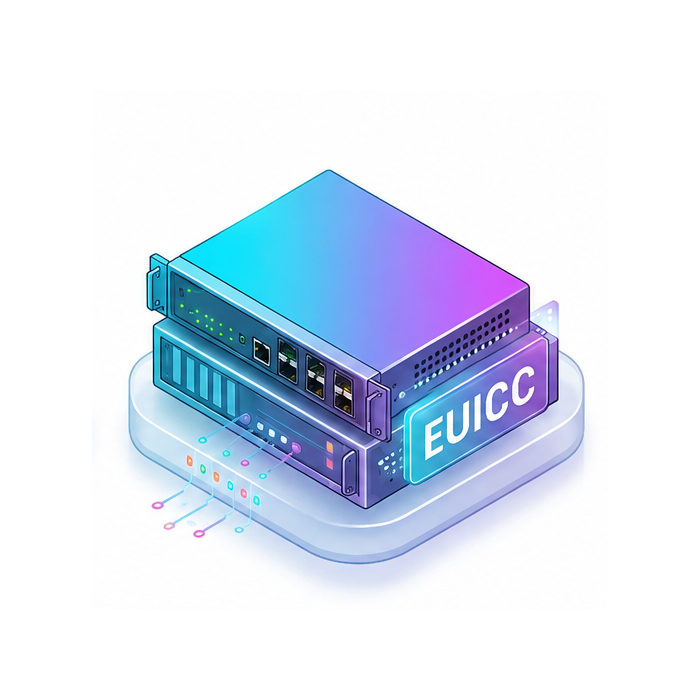
Enterprise routers
Carrier-managed or enterprise-IT devices. SD-WAN capable, multi-WAN failover, cloud management. Cradlepoint and Peplink sit in this category.
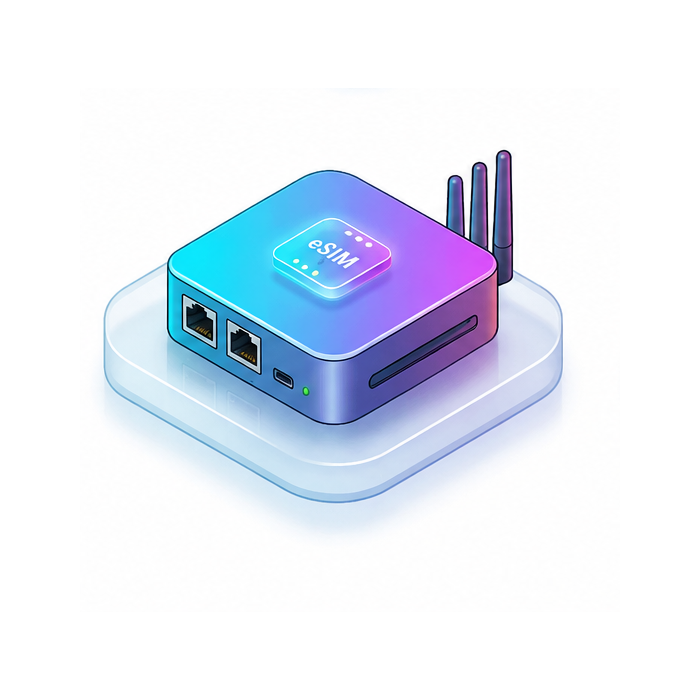
Compact routers
Small form factor units for retail, kiosk, and light commercial use. Wall or desk mount. Typically one SIM, Wi-Fi, and a small Ethernet switch.
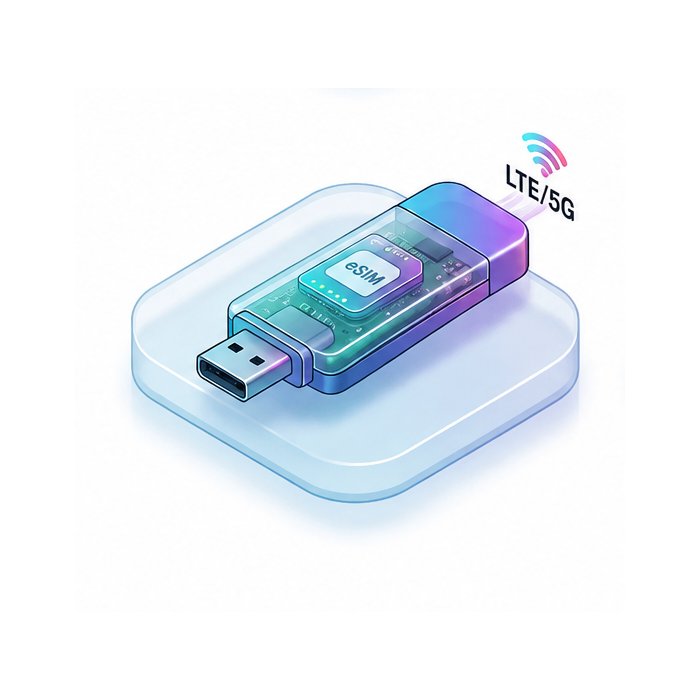
USB modems and dongles
Plug-in cellular adapters. No routing capability on their own – rely on the host device for network management. Useful for PC backup or low-cost single-device connectivity. See dongle.co.uk for UK options.
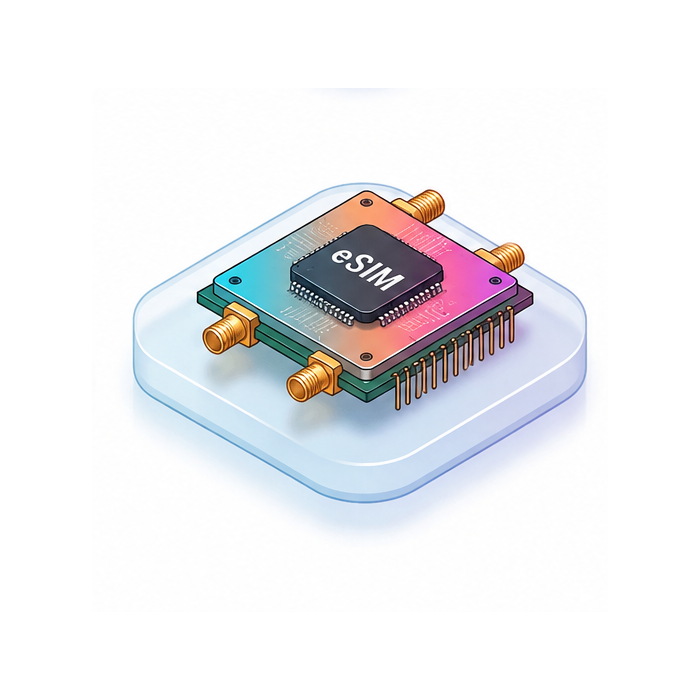
M2M modems
Embedded or standalone modems without routing. Used where the host device manages connectivity directly. Common in metering, vending, and SCADA applications.
eSIM router and gateway manufacturers
The industrial cellular router market is served by a large number of vendors, with varying levels of eSIM and eUICC support. Most current implementations use SGP.22 – full SGP.32 support is emerging in newer hardware generations.
| Brand | Origin | Key product lines | eSIM support | Notes |
|---|---|---|---|---|
| Teltonika | Lithuania | RUT200, RUT241, RUTX50, RUTM50, TRB series | SGP.22 | Widest UK IoT install base. RUT200 and RUT241 have dedicated eSIM variants. Strong FOTA and RMS remote management platform. See RUT200 eSIM review. |
| Robustel | China / UK | R1510, R2000, R3000, R5020 5G | Selective | Strong presence in UK utilities and smart metering. R5020 5G includes eUICC. RCMS cloud management platform. UK office and support. |
| Cradlepoint (Ericsson) | USA / Sweden | R920, R1900, E3000, IBR series | SGP.22 | Now owned by Ericsson. Enterprise and carrier-grade. NetCloud management platform. Strong in retail, transport, and public sector. Higher price point. |
| Milesight | China | UR32, UR35, UR75, UR32L | Selective | Good value industrial routers with strong UK distributor network. UR75 is a well-regarded 5G option. eSIM support varies by SKU – confirm before ordering. |
| Sierra Wireless (Semtech) | Canada | RV55, MP70, RV50X | SGP.22 | Long-established M2M brand. RV55 includes eUICC. Now part of Semtech. ALEOS firmware, AirLink Management Service. Strong in vehicle and industrial. |
| Digi International | USA | IX20, TX54, EX15 | Selective | US-origin, good European distribution. Digi Remote Manager cloud platform. TX54 is a dual-SIM rugged option popular in transport. |
| Peplink | Hong Kong | MAX BR1, MAX Transit, Balance series | Selective | Known for SpeedFusion bonding and multi-WAN. Popular for vehicle and maritime. InControl2 cloud management. Growing eSIM support in newer models. |
| InHand Networks | China | IR302, IR915, IR9000 | Selective | Compact DIN-rail units. Device Manager cloud platform. Good value for basic industrial gateway requirements. UK distribution available. |
| MultiTech | USA | MTR series, mPower routers | Selective | Long history in M2M. mPower OS with remote management. Used in utilities and industrial monitoring. UK distribution through specialist M2M resellers. |
| Advantech | Taiwan | ICR-series (formerly Conel) | Selective | Acquired Czech M2M vendor Conel. Wide range of compact industrial routers. ICR-3200 and ICR-4000 series for 4G/5G. Czech engineering heritage. |
| Westermo | Sweden | MRD series, Lynx, Wolverine | Limited | Focus on industrial networking for rail, energy, and harsh environments. IEC 61850 and substation-grade certifications. Less eSIM focus, more hardened connectivity. |
| Siretta | UK | SENET series, ZETA series | Selective | UK-designed and UK-supported. Based in Aldermaston, Berkshire. Strong presence in UK utilities and smart infrastructure. Good choice where UK support matters. |
| NetModule | Switzerland | NB800, NB1800, NB3800 | SGP.22 | Swiss-engineered, EN 50155 rail-certified options. Strong in European rail and public transport. NetModule Router Software (NRSW) platform. |
| Moxa | Taiwan | OnCell G4302, UC-Series | Limited | Industrial networking specialist. OnCell series for cellular. Strong in IEC-certified industrial and rail environments. Less focus on eSIM currently. |
| PUSR | China | G806, G810, USR-G781 | Limited | Budget-tier M2M modems and compact gateways. Popular for price-sensitive deployments. eSIM support limited. Useful for fixed, single-operator applications. |
eSIM support changes with firmware updates and new hardware revisions. Always confirm eUICC capability and the specific SGP version with the vendor before finalising hardware selection.
Why eSIM routers matter
Routers sit between the mobile network and the local device estate. That makes them a natural place to manage connectivity. A router can provide Ethernet, Wi-Fi, VPN, firewalling, serial interfaces, digital I/O and remote management alongside the cellular link.
The eUICC chip inside an eSIM router stores the operator profile and can receive new profiles over the air – meaning you can switch network operator without anyone visiting the site. For routers installed in remote plant, vehicle fleets, or locked cabinets, this changes the operational model significantly.
Where router platforms add value
Router management platforms can hide some of the awkwardness of profile installation. They can expose profile status, trigger workflows, report connection state and provide recovery options. This is why current SGP.22-based router implementations can still be valuable in IoT, even before SGP.32 is universally deployed.
Teltonika RMS, Cradlepoint NetCloud, Sierra Wireless ALEOS and Peplink InControl2 are examples of platforms that extend the value of the hardware through centralised visibility and control. The platform matters as much as the hardware – a capable router on a poor management platform is harder to operate at scale than a simpler router with good tooling.
Deployment checklist
- Confirm the exact router SKU supports eSIM/eUICC – not all models in a range do.
- Verify which SGP specification is supported (SGP.22 or SGP.32) and what that means for your management platform.
- Test profile installation in the lab before site deployment.
- Keep a physical SIM or known-good profile available as fallback where practical.
- Use VPN or managed remote access rather than exposing router services to the internet.
- Document the APN, profile owner, provider portal and recovery steps before installation.
- Confirm antenna type and connector – many eSIM routers still need external antennas for reliable signal.
- Check operating temperature range against the deployment environment – industrial and consumer specs differ significantly.
What to avoid
Do not assume eSIM removes the need for a site survey. Coverage, signal strength, and antenna placement still determine whether the connection is reliable. Do not assume all routers in a product family support the same SIM features – eSIM variants are often separate SKUs at different price points. Do not allow profile management to depend on one person’s laptop, browser session or undocumented portal login.
For deployments at scale, the inability to recover a failed profile remotely is a serious operational risk. Confirm the fallback procedure before deployment, not after a unit goes offline at 2am.
USB modems, dongles and mobile broadband devices
Not every cellular connectivity requirement needs a full router. USB modems and mobile broadband dongles provide cellular connectivity to a host device without the overhead of a separate routing platform. They are widely used for laptop backup connectivity, temporary site connections, and low-cost single-device applications.
Key vendors in the UK dongle and mobile broadband device market include Huawei (E3372 and E5576 series), ZTE (MF823, MF833), Netgear (Nighthawk M series), and various carrier-branded devices from EE, Vodafone, and Three. eSIM support in the dongle category is still limited but growing. For a comprehensive guide to UK mobile broadband dongles and devices, see dongle.co.uk.
eSIM Router Guides
Detailed guides to individual eSIM router models – specs, key features, eSIM behaviour, and where to buy in the UK.
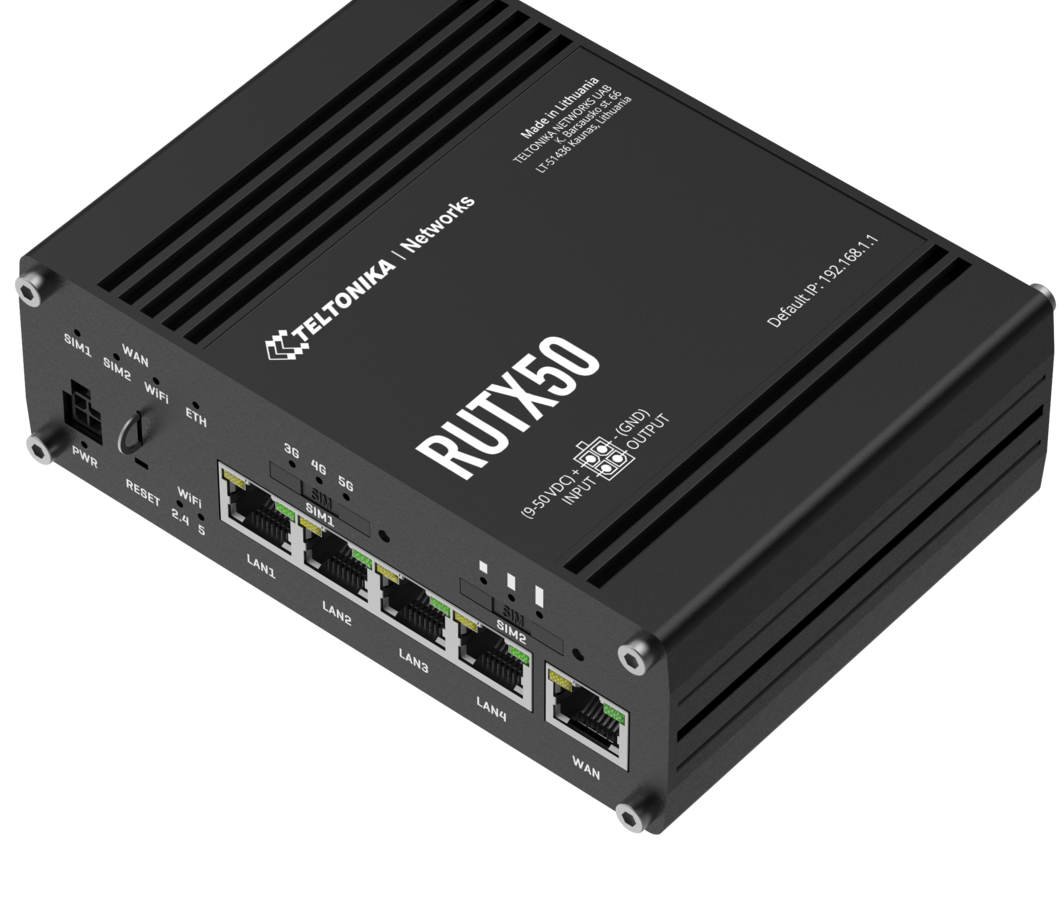
Teltonika RUTX50 eSIM
5G industrial router with dual-band Wi-Fi, five Gigabit Ethernet ports, and the full RutOS feature set. The eSIM variant adds SGP.22 eUICC for remote profile management and dual-MNO carrier diversity without two physical SIM cards.
- Quectel RM502Q-AE modem · 3.3 Gbps peak downlink
- SMS control direct to router SIM number
- WireGuard, OpenVPN and IPsec VPN suite
- MWAN3 dual-MNO failover
- Built-in GNSS · digital I/O · RMS remote management
- -40 to +75°C · DIN-rail mount · aluminium enclosure