
Teltonika RUT200 eSIM Router: Affordable SGP.22 Connectivity with Remote Profile Management
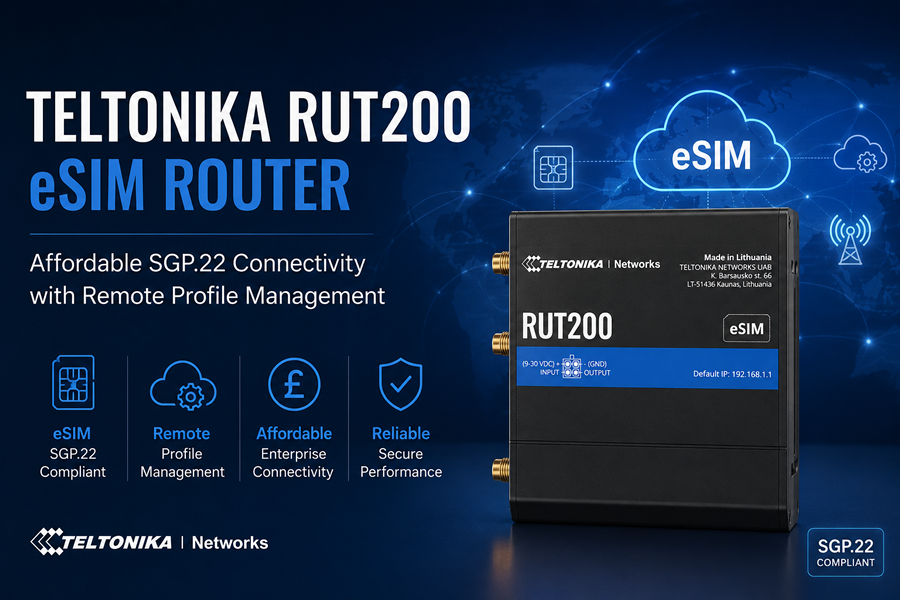
Teltonika has extended its popular RUT200 compact 4G router range to include eSIM variants, and it is one of the most significant moves in the low-cost industrial eSIM router market to date. The RUT200 eSIM brings certified SGP.22 eUICC connectivity to one of the most widely deployed compact IoT routers in the world – at a price point that makes remote SIM management accessible for cost-sensitive deployments.
This page explains exactly how the RUT200 eSIM works, how Teltonika uses the SGP.22 standard alongside a bootstrap SIM and its Remote Management System (RMS) to deliver a remote management experience that closely mirrors what you would expect from a fully native SGP.32 device – and what that means for your IoT deployment.
What Is the Teltonika RUT200 eSIM?
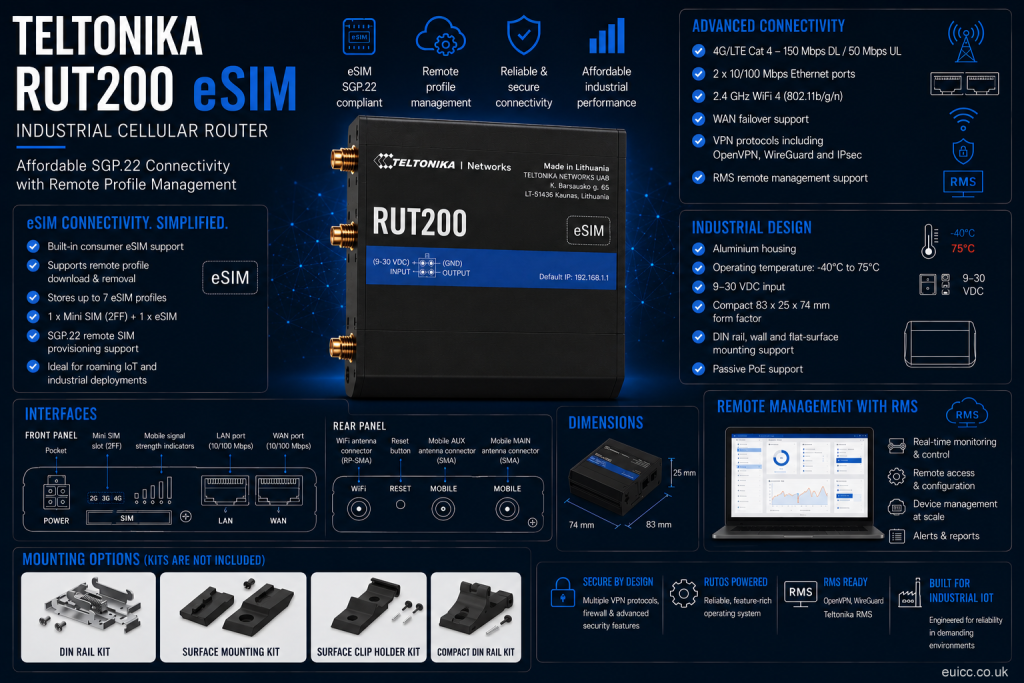
The RUT200 is a compact industrial 4G LTE Cat 4 router in an aluminium IP30 enclosure weighing just 125 g. It has been a firm favourite in IoT deployments across CCTV, utilities, remote monitoring, BMS and kiosk applications for several years, primarily due to its balance of industrial build quality, full RutOS software capability and competitive pricing.
The eSIM variants – order codes beginning RUT200 31**** and RUT200 34**** – add an integrated eUICC chip alongside the existing Mini SIM (2FF) physical slot. This gives the router two SIM paths: the eSIM chip supporting up to seven stored operator profiles, and the physical slot for a traditional SIM card. Both are managed through the RutOS WebUI and through Teltonika RMS.
The addition of eSIM does not change the physical footprint, the connectivity specification or the operating temperature range of the router. It is the same device with an additional capability baked in at manufacture.
How Teltonika Implements eSIM: SGP.22 + Bootstrap SIM + RMS
Understanding how Teltonika delivers eSIM in the RUT200 is important, because the implementation is more sophisticated than simply soldering an eUICC chip to the board.
The SGP.22 Foundation
Teltonika’s eSIM implementation across the RUT200 and its wider router range is built on the GSMA SGP.22 standard. SGP.22 defines the architecture for consumer remote SIM provisioning and is the most widely supported eSIM standard in the world. It underpins the eSIM functionality in smartphones, tablets and wearables, and its ecosystem of SM-DP+ servers, mobile operator integrations and provisioning tools is mature and extensive.
Critically, the RUT200 eSIM also complies with the companion standards SGP.23 (technical specification) and SGP.24 (conformance testing), and the hardware incorporates a TPM 2.0 security chip. This means the eUICC implementation is properly certified, not a cut-down interpretation.
The eUICC chip supports up to seven profiles simultaneously, with one active at any time. Profiles are downloaded over the air from an SM-DP+ server. Switching between profiles can be triggered manually via the WebUI, by an automated policy rule within RutOS, or remotely via Teltonika RMS.
The Bootstrap SIM
A key engineering challenge with any eSIM device is the chicken-and-egg problem: how does a device get online to download its first eSIM profile when it has no profile loaded yet?
Teltonika solves this in the same way the wider industry handles it – through a pre-loaded bootstrap profile. The RUT200 eSIM ships with a bootstrap (or boot loader) SIM profile already resident on the eUICC. This bootstrap profile provides limited connectivity – sufficient to reach the SM-DP+ provisioning server and pull down an operational profile – without requiring a physical SIM card in the device.
For deployments where the RUT200 ships direct to a field location, this means the device can come online, authenticate with the provisioning platform, download the target operator profile and activate it, all without an engineer needing to carry a SIM card or physically touch the device. Zero-touch provisioning becomes genuinely achievable.
The physical Mini SIM slot remains available as a fallback or secondary path throughout, providing an additional layer of resilience.
RMS as the Remote Management Layer
Where Teltonika’s implementation becomes particularly powerful is through the integration with Teltonika RMS – the Remote Management System that underpins the company’s entire router portfolio.
RMS allows operators to manage eSIM profiles at scale across deployed fleets of RUT200 and other Teltonika eSIM devices from a single dashboard. This includes switching active profiles, triggering profile downloads, monitoring SIM status and responding to connectivity events – all remotely, without site access.
This combination of SGP.22 hardware and RMS software addresses a common misconception: that SGP.22-based devices inherently lack serious remote management capability. Teltonika’s position is clear – they have taken the wide compatibility of SGP.22 and layered centralised, server-side remote control on top, creating a management experience that closely mirrors the server-initiated profile management that is the headline feature of SGP.32. In many real-world fleet deployments, the practical difference is minimal.
SGP.22 vs SGP.32: What Is the Actual Difference for IoT Router Deployments?
This is a question that comes up repeatedly in conversations about Teltonika eSIM devices. The answer is nuanced and worth working through properly.
For a deeper technical treatment of both standards, see the SGP.32 explainer on sgp32.co.uk and the What Is SGP.32 guide on this site.
The Short Version
| SGP.22 | SGP.32 | |
|---|---|---|
| Primary design target | Consumer devices (phones, tablets) | IoT / headless devices |
| Profile activation model | Device-initiated (pull) | Server-initiated (push) |
| User interface required | Typically yes (QR code, app) | No |
| Remote fleet management | Requires additional tooling (e.g. RMS) | Native via eIM |
| Constrained network support | Limited | NB-IoT, LTE-M, CoAP/UDP |
| SM-DP+ compatibility | Yes | Yes (reuses SGP.22 SM-DP+) |
| Hardware ecosystem | Vast – widest available | Growing, still maturing |
| Current availability | Widely available | Reaching market now |
What SGP.22 Does Well
SGP.22 benefits from years of deployment at global scale. The SM-DP+ server infrastructure is established, operator support is broad, and certified hardware is abundant. For a 4G router like the RUT200 – a connected device with a management interface, persistent power and a network connection – SGP.22 is a highly practical choice.
The profile management flow in SGP.22 is device-initiated: the device requests a profile change and pulls it from the server. This works perfectly well for a managed router, where the device is reachable, powered and capable of initiating that request on command from RMS.
Where SGP.32 Has the Edge
SGP.32 was designed for a different problem: truly constrained devices with no user interface, no persistent power and no guarantee of a stable IP connection. Think livestock trackers, smart meters in deep coverage locations, NB-IoT sensors running on coin cells with years of expected battery life.
For these devices, SGP.22’s device-initiated pull model is often impractical. The device may be in deep sleep (PSM mode), on a narrowband network that cannot support TLS sessions, or simply unreachable. SGP.32 solves this with a server-push architecture via the eIM (eSIM IoT Manager) and a lightweight IPA (IoT Profile Assistant) that can operate over CoAP/UDP rather than requiring a full TCP/TLS stack.
For an industrial 4G router on permanent mains or PoE power with a full IP stack and RMS connectivity – like the RUT200 – these constraints simply do not apply.
The Honest Assessment
For Teltonika RUT200 deployments, SGP.22 plus RMS is a genuinely capable eSIM solution. The bootstrap SIM handles initial provisioning. RMS handles remote profile management at fleet scale. The wide operator and SM-DP+ compatibility of SGP.22 keeps options open. The TPM 2.0 security chip keeps it enterprise-grade.
Where SGP.32 native would offer additional value – automated server-push profiles with no device-side action required, and operation on constrained NB-IoT or LTE-M links – the RUT200 is not a target platform anyway. It is a 4G Cat 4 router. SGP.22 with RMS is the right tool for this application.
The key question for any deployment is not “is this SGP.32?” but “does this solve my eSIM management problem?” For most industrial IoT router deployments, the RUT200 eSIM answers that question positively.
Key Benefits of the Teltonika RUT200 eSIM for IoT Deployments
No SIM swap requirement at remote sites. Substations, pump stations, traffic cabinets, rooftop CCTV installations – anywhere physical SIM access is difficult or expensive. An eSIM profile swap happens remotely via RMS with no engineer visit needed.
Up to seven stored profiles. Profiles from different operators can be stored simultaneously. If primary connectivity fails or becomes unacceptable on cost or coverage grounds, the switch to an alternative profile is immediate and remote.
Physical SIM slot retained. The Mini SIM slot remains active. This allows a physical SIM to run in parallel – useful for deployments where an existing SIM contract has time to run, or as a hard fallback if eSIM provisioning encounters an issue.
Automatic SIM/eSIM failover. RutOS can be configured to trigger a profile switch automatically based on signal quality, data limit thresholds, roaming status, or connection failure events. This is genuine resilience, not just a manual switch capability.
Industrial build quality. -40 to +75 degrees C operating temperature, IP30 aluminium enclosure, 9-30 V DC or passive PoE input. The eSIM variants carry the same hardware specification as the standard RUT200.
Full RutOS capability. OpenVPN, WireGuard, IPsec, Modbus TCP/RTU, MQTT, DNP3, OPC UA, SNMP, SMS and call management, TR-069, FOTA. This is the same firmware stack that makes RUT200 a serious industrial device, not a consumer grade router.
RMS fleet management. Centralised dashboard for profile management, firmware updates, configuration, monitoring and alerting across deployed fleets of any size.
Low entry cost. The RUT200 is one of Teltonika’s most accessible price points. Adding eSIM capability at this tier opens remote SIM management to applications and projects where the cost of higher-end eSIM routers would be prohibitive.
Technical Specification
| Parameter | Value |
|---|---|
| LTE standard | 4G LTE Cat 4 |
| Download speed | Up to 150 Mbps |
| Upload speed | Up to 50 Mbps |
| LTE FDD bands (Europe/EMEA variants) | B1, B3, B5, B7, B8, B20, B28 |
| LTE TDD bands | B38, B40, B41 |
| 3G | B1, B8 |
| 2G | B3, B8 |
| eSIM standard | SGP.22 / SGP.23 / SGP.24 |
| eSIM profiles | Up to 7 stored |
| Physical SIM | 1x Mini SIM (2FF) |
| SIM failover | Automatic (signal, data limit, roaming, connection failure) |
| Security | TPM 2.0 |
| Wi-Fi | 802.11b/g/n, 2.4 GHz, up to 50 clients |
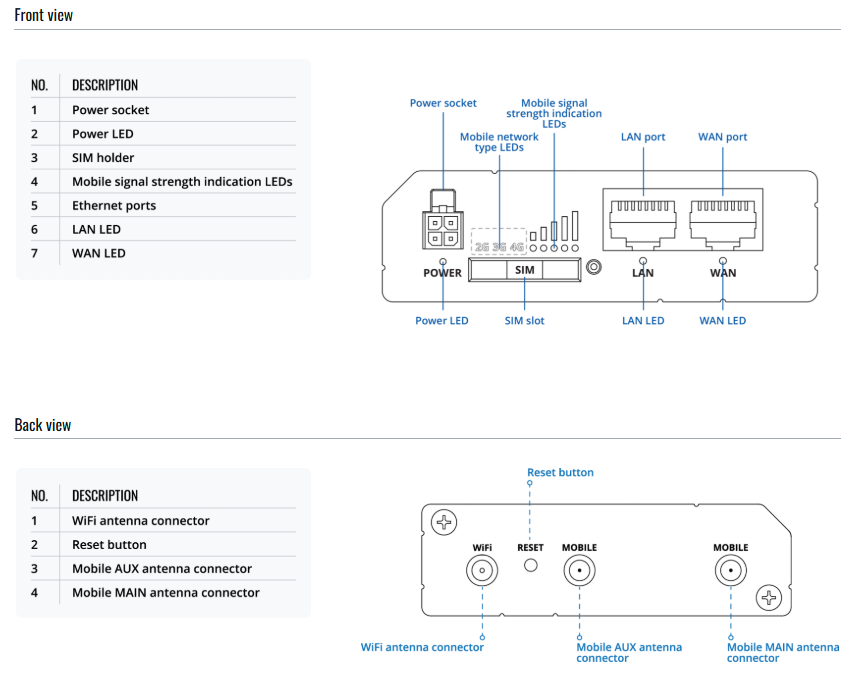
| Ethernet | 1x WAN + 1x LAN, 10/100 Mbps (WAN configurable as LAN) |
| I/O | 1x Digital Input, 1x Digital Output (4-pin industrial connector) |
| Power input | 9-30 V DC or passive PoE (Mode B) on LAN1 |
| Power consumption | 9 W maximum |
| Operating temperature | -40 to +75 degrees C |
| Ingress protection | IP30 |
| Enclosure | Aluminium |
| Weight | 125 g |
| VPN | OpenVPN, WireGuard, IPsec, GRE, PPTP, L2TP |
| Protocols | Modbus TCP/RTU, MQTT, DNP3, OPC UA, SNMP |
| Management | RutOS WebUI, Teltonika RMS, TR-069, SNMP, SMS, FOTA |
Available Versions and Part Numbers
The eSIM is available across two hardware versions of the RUT200.
RUT200 31**** – Europe, Australia, Asia-Pacific
Frequency support: 4G LTE FDD B1, B3, B5, B7, B8, B20, B28 / LTE TDD B38, B40, B41 / 3G B1, B8 / 2G B3, B8
| Order Code | Package |
|---|---|
| RUT200310000 | Standard package with EU PSU |
| RUT200311030 | Mass packing |
RUT200 34**** – EMEA, Thailand, Australia, New Zealand
Frequency support: 4G LTE FDD B1, B3, B5, B7, B8, B20, B28 / LTE TDD B38, B40, B41 / 3G B1, B8 / 2G B3, B8
| Order Code | Package |
|---|---|
| RUT200340000 | Standard package with EU PSU |
| RUT200343000 | Standard package with UK PSU |
For UK deployments, RUT200343000 is the correct SKU – standard package with UK power supply unit.
Note: The eSIM variants sit alongside the existing non-eSIM RUT200 range. The eSIM hardware versions are distinguished by the 31 and 34 hardware version codes. When ordering, confirm the hardware version to ensure you receive the eSIM-capable variant.
Use Case Applications
CCTV and security systems. Rooftop and traffic cabinet installations where physical SIM access requires cherry pickers or specialist clearance. An eSIM profile swap is a remote operation taking minutes.
Utilities and smart metering. Substations, pump stations, water treatment sites and renewable energy installations. Often unmanned, often in poor coverage locations. The RUT200 eSIM allows network switching if primary coverage becomes unacceptable, without a site visit.
Retail and kiosks. Payment terminals, digital signage and vending applications where devices are locked in cabinets and SIM access is impractical without disrupting the installation.
Fleet and transport. Vehicle-mounted applications with the RUT200 used as a primary connectivity device. Profile switching between operators depending on geographic coverage.
Temporary and mobile deployments. Construction sites, events, pop-up locations. A single device SKU can be provisioned for different operator contracts depending on where it is deployed.
Global distribution. Where devices ship to multiple countries from a single warehouse. The bootstrap SIM allows initial provisioning at destination rather than requiring country-specific SIM pre-loading.
Where This Fits in the Teltonika eSIM Router Range
Teltonika has been building out its eSIM portfolio progressively. The RUT241 was an early eSIM model at the compact industrial router tier. Higher-specification models including the RUTM30 and RUTM52 carry eSIM alongside more powerful connectivity options.
The RUT200 eSIM sits at the entry tier of that portfolio – the lowest cost point where you can get Teltonika’s full RutOS and RMS capability with integrated eSIM. For high-volume, cost-sensitive deployments, that positioning matters.
For a broader view of Teltonika’s eSIM router range and other eSIM-capable hardware covered on this site, see the eSIM Routers page and the eSIM Hardware for IoT page.
RUT200 eSIM and eUICC: Key Concepts
For readers who are newer to eUICC and eSIM terminology, a quick reference:
eUICC (embedded Universal Integrated Circuit Card) is the software specification running on the eSIM chip that enables secure remote profile management. The RUT200 eSIM chip is an eUICC-compliant component.
SGP.22 is the GSMA standard defining the architecture for remote SIM provisioning. It is the technical foundation of the RUT200 eSIM implementation. For a full explanation, see the eSIM page and the eUICC FAQ.
SM-DP+ (Subscription Manager Data Preparation Plus) is the server that stores and delivers encrypted eSIM profiles to the device. Teltonika works with certified SM-DP+ providers as part of the RMS eSIM management flow.
SGP.32 is the newer GSMA standard designed specifically for constrained IoT devices. For a detailed comparison and explanation of why the RUT200’s SGP.22 implementation is appropriate for its use case, see the SGP.22 vs SGP.32 comparison, the SGP.32 guide on this site, and the SGP.32 definitive guide at sgp32.co.uk.
Bootstrap profile is the initial profile pre-loaded onto the eSIM at manufacture. It provides limited connectivity to allow the device to reach the provisioning server and download its first operational profile.
SIM Card Pairing for the RUT200 eSIM
The RUT200 eSIM works with any SGP.22-compatible eSIM profile from a supporting mobile operator or MVNO. For UK deployments, this typically means working with a connectivity provider who can provision profiles onto the device via an SM-DP+ server compatible with Teltonika’s RMS eSIM management flow.
The physical Mini SIM slot accepts standard 2FF SIM cards and can be used with any standard IoT SIM – including multi-network roaming SIMs, fixed IP SIMs, and single-network contracts.
For multi-network resilience using the physical SIM slot alongside eSIM, see the IoT Connectivity Solutions page and the Fixed IP SIM Cards page for options that complement the RUT200 eSIM in deployment.
Buy the Teltonika RUT200 eSIM
The RUT200 eSIM is available from Router Store UK. The dedicated product page includes full ordering information for UK buyers, with the RUT200343000 (UK PSU variant) as the standard UK SKU.
Summary: Is the Teltonika RUT200 eSIM Right for Your Deployment?
The RUT200 eSIM is a compact, cost-effective industrial 4G router with a properly implemented SGP.22 eUICC, up to seven stored profiles, automatic SIM failover and full Teltonika RMS remote management. For deployments where eliminating the cost and logistics of physical SIM management is the goal, and where the device is a powered 4G router rather than a constrained sensor or meter, this is a strong solution.
It is not a native SGP.32 device. For constrained NB-IoT or LTE-M devices, or for applications requiring genuinely server-pushed profiles with no device-side action on low-power links, the SGP.32 ecosystem is the right direction. But for the majority of industrial IoT router deployments, the RUT200 eSIM delivers what the application actually needs.
Low cost. Industrial grade. Properly implemented eSIM. Full remote management via RMS. That is a compelling combination.
For implementation guidance on planning an eSIM router deployment, see the eUICC Implementation Guides. For a broader introduction to eUICC and eSIM, see The Ultimate Guide to eSIM and eUICC.
YOAST / AIOSEO META DESCRIPTION (paste into SEO plugin – 155 chars):
Teltonika RUT200 eSIM router explained. How SGP.22, a bootstrap profile and Teltonika RMS combine to deliver remote eSIM fleet management at an accessible price point.