
SGP.32 eUICC Deep Dive: Packages, Profile States and Certification Explained
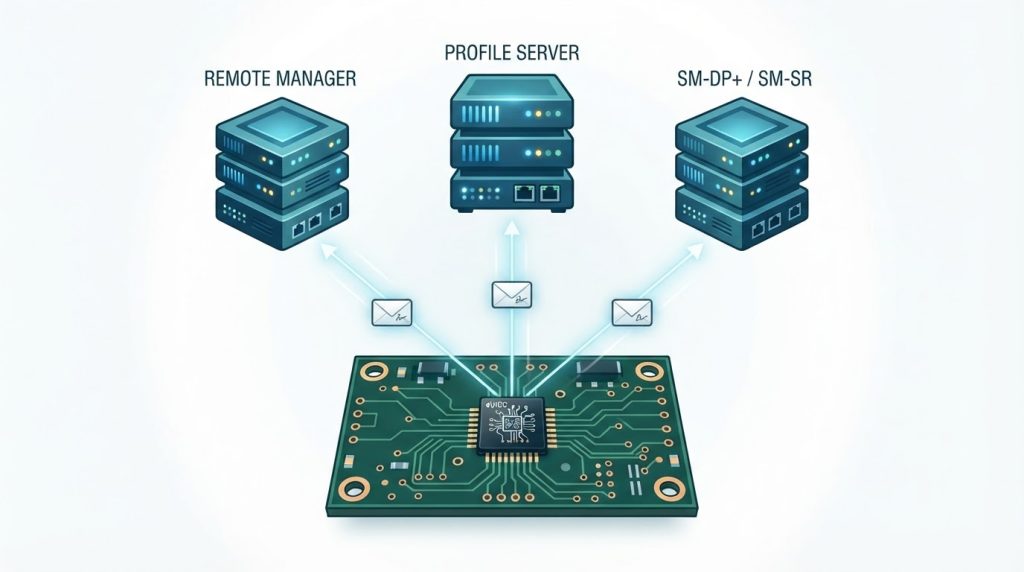
Most SGP.32 eUICC explainers stop at the org chart: there is an eIM, there is an IPA, there is an SM-DP+, and somehow profiles move about. Fine as far as it goes, but if you are the one who has to sign off a device that will sit in a cabinet until the mid-2030s, you need to know what the chip actually does when an instruction arrives. In October 2026 the Trusted Connectivity Alliance (TCA) published a proper technical guide to IoT eSIM, written by its IoT RSP Working Group and based on SGP.32 v1.3. It is a good document. It is also dense standards prose. So I have gone through it, redrawn the important bits, and added my own view on where the sharp edges are.
SGP.32 eUICC: the short version
- SGP.32 is the GSMA’s IoT eSIM technical specification. It grew out of the consumer spec, SGP.22, which itself grew out of the original M2M spec, SGP.02. The big change is that profile management is driven by a server, not a person.
- Two new roles do that work: the eIM (eSIM IoT Remote Manager), which sends orders, and the IPA (IoT Profile Assistant), which carries them to the chip. The SM-DP+ profile server is the same one consumer eSIM already uses.
- The eUICC only obeys signed packages from an eIM it has been associated with. Every package carries the target EID and an anti-replay counter, and every result goes back signed.
- Profiles move through intermediate states (“to be enabled”, “to be disabled”) and nothing switches until the whole package has run.
- Three things get certified separately: the eUICC, the eIM and (if used) the device-side IPA. All three end with a GSMA SGP.24 declaration.
Where SGP.32 came from, and why the eUICC needed a new boss
SGP.02 (2014) was server-driven but welded to the operator. SGP.22 (2016) freed the profile from the operator but assumed a human with a phone and a QR code. Neither suits a water meter. SGP.32 keeps the good parts of both: the SM-DP+ download machinery and profile security from SGP.22, plus the server-side control and the fallback ideas from SGP.02. The 2024 release (v1.2) is the one that went into shipping products; the TCA guide is written against v1.3, which tidies things up. If you want the whole standard in one place, sgp32.co.uk is where I keep the long-form SGP.32 library.
One point in the guide that I think deserves more attention than it gets: the SM-DS, the discovery server from consumer eSIM, is still in the architecture diagram, but the TCA says plainly it may not be used in IoT at all, because the eIM can already reach both the device and the SM-DP+. It is in the drawing mostly for historical reasons. Like the ashtray in an old car.
The eIM and the IPA: who does what
The eIM is the fleet’s remote control. Per the TCA, it does five jobs: it talks to the IPA securely, it sends Profile State Management Operations (enable, disable, delete), it changes eIM configuration on the chip, it decides which profile is the fallback, and it can proxy profile downloads when the device cannot reach the SM-DP+ itself.
The IPA is the go-between, the IoT cousin of the LPA in a phone. It comes in two flavours, and the choice matters more than most spec sheets admit.
| IPAd (in the device) | IPAe (in the eUICC) | |
|---|---|---|
| Where it lives | Device firmware or OS | On the eUICC itself |
| Best for | Devices with some processing and networking headroom | Ultra-constrained devices, or firmware you cannot easily change |
| Security evaluation | Separate IPAd functional certification (SGP.33-2) | Covered by the eUICC’s own security evaluation |
| Getting connectivity details | GetConnectivityParameters command | Internal, implementation-specific eUICC mechanism |
| When it runs | Device chooses it | Activates automatically if no IPAd is present and the eUICC supports it |
That last row is the one I like. If the device has no IPAd, a capable eUICC simply gets on with the job itself. That is exactly why a removable IPAe card can bring SGP.32 to a router that never heard of it, as long as the modem supports the plumbing. I go further into the trade-offs over at IPAe vs IPAd on sgp32.co.uk.
Direct vs indirect profile download
A profile can reach the eUICC two ways. In a direct download the device opens HTTPS to the SM-DP+ itself, much like a phone does. The eIM can kick it off, or the device can start it from an activation code or a default SM-DP+ address. In an indirect download the eIM triggers the download and sits in the middle as a proxy, so the device only ever talks to one server. The device-to-eIM leg can be HTTPS, CoAP, or a transport the device already runs such as MQTT or LwM2M, and the eIM can translate between protocols.
Either way the core of the download is inherited from consumer eSIM: the SM-DP+ and eUICC authenticate each other, the SM-DP+ checks eligibility, sends signed profile metadata, and the profile installs. Two details worth knowing. First, if the IPA is too constrained to verify the metadata, the eIM does it instead. Second, the download is not “finished” when the profile lands. The eUICC produces a Profile Installation Result, the IPA passes it to whoever is configured to receive notifications, and only once those are acknowledged and cleared from memory can the eIM start enabling or disabling things. If you have ever wondered why a fleet job looks stuck after a successful download, check your notification handling first.
eIM packages and eUICC packages
This is the bit most explainers skip, and it is the bit that makes SGP.32 trustworthy. There are two envelopes, one inside the other.
- An eIM Package is the outer envelope. The eIM addresses it to the IPA or the eUICC, and it can carry an eUICC Package, a profile download trigger, a request for IPA or eUICC information, or an acknowledgement for notifications already received.
- An eUICC Package is the sealed letter inside. It is signed by the eIM and holds either profile operations (PSMOs) or eIM configuration operations (eCOs). Not both: in the current version you cannot mix them in one package.
Every eUICC Package carries the eIM’s identifier, the EID of the one chip it is meant for, an anti-replay counter and, optionally, a transaction ID. The IPA can carry it but cannot open it or tamper with it. That is the whole point.
Profile states: what really happens when you “switch operator”
Here is where the SGP.32 eUICC earns its keep. Profile changes do not happen instantly, they are staged. When an Enable arrives, the target profile goes to “to be enabled” and the current one goes to “to be disabled”. Nothing actually flips until every operation in the package has run. That is what stops a half-finished package leaving a device with no working profile at all.
The rules the eUICC enforces, in plain English:
| Operation | Only allowed when | Watch out for |
|---|---|---|
| Enable | Target profile is disabled | Can be sent with a rollback flag, so the IPA can revert if the new profile cannot reach the eIM |
| Disable | Target profile is enabled | Must be followed by an Enable in the same package, or you have just cut the device off |
| Delete | Profile is disabled or “to be disabled” | Refused if it is pending enable or is the rollback or fallback target. Deleting provisioning or test profiles may not be supported at all |
| Set fallback | eUICC supports fallback; profile allows it; not the emergency profile | Only one profile can hold the attribute. Fails if the current fallback profile is the enabled one |
| Unset fallback | A fallback profile exists | Afterwards, no profile holds the attribute |
| Immediate enable | A default SM-DP+ is configured | Downloaded profile activates without further eIM or SM-DP+ involvement |
The Disable rule is the one I would tattoo on the back of every platform developer’s hand. A Disable on its own is a perfectly valid instruction that leaves a perfectly certified device sitting in a field talking to nobody. The spec lets you. Your eIM tooling should not.
Fallback, rollback and emergency profiles
These three get muddled constantly, so here they are side by side.
| Rollback | Fallback | Emergency profile | |
|---|---|---|---|
| Inherited from | SGP.02 | SGP.02 | SGP.02 |
| When it kicks in | Straight after an enable, if the device cannot reach the eIM | Later, when connectivity is lost | In a critical situation; stays enabled until the device disables it |
| What it switches to | The previously enabled profile | The profile holding the fallback attribute | A designated emergency profile |
| Mandatory? | Requested per enable | eUICC-dependent | No; driven by regional regulation |
Rollback and fallback are both triggered from the IPA. Note too that an emergency profile is not the same as eCall. With eCall the device makes its emergency call on whatever profile is already enabled.
eIM configuration: association, swaps and multiple eIMs
An eUICC will not take a single order from an eIM it does not know. “Association” loads the eIM’s configuration data onto the chip: at minimum its identifier and public key or keys, checked for compatibility with the eUICC and the device. From then on, anything signed with that eIM’s private key is trusted.
- The first eIM is either loaded by the eUICC manufacturer at the factory, or added later by the IPA with an “Add initial eIM” function. How the IPA gets that data is left to the device maker.
- After that, only an associated eIM can change the eIM configuration: add, remove or update.
- Swapping eIM provider is a two-step handshake: the current eIM adds the new one, then the new one removes the old one.
- A reset lets the IPA wipe all eIM configuration and re-add a first eIM.
- Multiple eIMs can be associated at once, but the spec does not say which one wins.
Read the swap rule twice, because it is the commercial reality of SGP.32 in one line. Moving to a new eIM needs the co-operation of the one you are leaving. That is why independent eIMs matter, and why “who controls the eIM” is the first question I would ask any provider. There is more on that at eSIM IoT Manager.
If you are drawing up a shortlist, the IoT Directory’s eSIM and SGP.32 listings are a good place to start, with entries for providers such as Onomondo, Eseye and 1GLOBAL. Ask each of them the swap question.
Connectivity parameters: the chicken-and-egg problem
To talk to the eIM or SM-DP+, the IPA needs a data connection, which means an APN and possibly credentials. Lots of IoT devices cannot hold long parameter lists, so SGP.32 lets the IPA read them out of the currently enabled profile. The IPAd uses a GetConnectivityParameters command; the IPAe uses its own internal route. If an operator forgot to include them at install, they can be pushed later over ES6, the operator’s OTA channel to its own profile. On private networks, the TCA’s advice is simple: put the parameters in the profile, because the device will not guess them.
And the egg? If no profile is enabled, SGP.32 does not say which parameters to use. An IPAe might open a BIP channel on the default bearer and let the device sort it out. That is not a design, that is a shrug, and it is one of the gaps the TCA itself flags.
Certification: three routes, one declaration
The SM-DP+ certification does not change for IoT. The same SM-DP+ serves phones and meters. Everything else gets its own route.
| Spec or scheme | What it covers | Who runs it |
|---|---|---|
| SGP.31 / SGP.32 | Requirements / technical specification | GSMA |
| SGP.33-1 | eUICC functional tests | GlobalPlatform, on GSMA’s behalf |
| SGP.33-2 | IPA (IPAd) functional tests | GCF or PTCRB |
| SGP.33-3 | eIM functional tests | Vendor or third-party test tools, or field interop |
| SGP.25 v2.1 | eUICC Protection Profile (consumer and IoT), Common Criteria | GSMA eSA or EUCC schemes |
| SAS-SM | Security accreditation for subscription management (eIM, SM-DP+) | GSMA (equivalent accepted for eIMs) |
| SAS-UP | Security accreditation for UICC and eUICC production | GSMA |
| SGP.24 | Compliance process and declaration forms | GSMA |
One honest observation: the eIM is the only component whose functional testing can be done with the vendor’s own tooling. The TCA says it is looking at gaps in the GSMA test infrastructure, and I would bet the eIM is near the top of that list. If you are buying an eIM, ask exactly how it was tested and against which eUICCs. “Certified” on its own does not tell you it will work with your chips. I made a similar point about what Kigen’s starter kit really tests.
The gaps the TCA admits to
Credit where it is due: the guide does not pretend SGP.32 is finished. These are the open points it names, with my take on why each one matters in the real world.
| Open issue | Why it bites |
|---|---|
| No priority order across multiple eIMs | The IPA decides, so two devices on the same eUICC could behave differently depending on firmware |
| No connectivity parameters defined when no profile is enabled | The recovery path for a “bricked” device is implementation-dependent |
| PSMOs and eCOs cannot share a package | An eIM change plus a profile change is always at least two round trips over a slow link |
| Deleting provisioning or test profiles may be unsupported | Your bootstrap profile may be with you for life; check its commercial terms accordingly |
| Gaps in GSMA test infrastructure | Interoperability between certified parts is not guaranteed; trial on your own hardware |
None of these is a reason not to use SGP.32. All of them are reasons to read the small print, which, if you have been in this game since GPRS, is hardly news. If you want the longer view on what the chip can and cannot protect you from, see future-proof IoT eSIM.
Frequently asked questions
What does the eUICC do in SGP.32?
The eUICC stores the operator profiles and the eIM configuration, and it is the final authority on every instruction. It verifies each signed eUICC Package against the eIM’s key, its own EID and an anti-replay counter, runs the operations, and returns a signed result.
What is the difference between an eIM Package and an eUICC Package?
An eIM Package is the outer container the eIM sends to the IPA or eUICC; it can carry a download trigger, a data request, notification acknowledgements or an eUICC Package. An eUICC Package is the signed inner payload holding either profile operations or eIM configuration operations, which only the eUICC can verify and execute.
What is the difference between IPAd and IPAe?
IPAd runs in the device firmware or OS and needs its own SGP.33-2 certification. IPAe runs on the eUICC itself, suits very constrained devices, and is covered by the eUICC’s security evaluation. If no IPAd is present, a capable eUICC activates its IPAe automatically.
What is the difference between fallback and rollback in SGP.32?
Rollback happens immediately after a profile is enabled if the device cannot reach the eIM, and restores the previous profile. Fallback happens later when connectivity is lost, and switches to whichever profile holds the fallback attribute.
Can you change eIM provider on an SGP.32 eUICC?
Yes. The current eIM adds the new eIM’s configuration, then the new eIM removes the old one. The outgoing eIM has to co-operate, so check the exit terms before you sign.
How is an SGP.32 eUICC certified?
It passes SGP.33-1 functional testing through GlobalPlatform, SGP.25 security certification through GSMA eSA or EUCC (including any IPAe), is made in a SAS-UP accredited facility, and the manufacturer then declares compliance to the GSMA on SGP.24 forms.
Is SM-DS used in IoT eSIM?
It is in the SGP.32 architecture, but the TCA notes it may not be used in IoT, because the eIM can already reach both the device and the SM-DP+.
This guide is my own reading of the Trusted Connectivity Alliance technical paper “IoT eSIM (SGP.32): A Technical Guide” (v1.0, October 2026), with redrawn diagrams and added commentary. euicc.co.uk is independent and has no commercial relationship with the TCA.
Related reading
- SGP.32 explained: eIM, IPA and eUICC
- What is an eUICC? The chip that makes IoT eSIM possible
- SGP.22 vs SGP.32: the quick comparison
- The plastic eUICC and SGP.32: retrofitting a router estate
- Onomondo’s independent SGP.32 eIM
- sgp32.co.uk: the SGP.32 resource library
- SGP.32 architecture (sgp32.co.uk)
- SGP.32 modem compatibility: BIP, STK and firmware (sgp32.co.uk)
- eSIM IoT Manager: the eIM explained
- IoT Directory: eSIM companies and products
Sources
- Trusted Connectivity Alliance: IoT eSIM (SGP.32): A Technical Guide, v1.0, October 2026 (PDF)
- GSMA eSIM consumer and IoT specifications register
Further reading: for why SGP.32 hardware is still catching up, whose fault that is, and why a plastic SGP.32 SIM is the practical bridge for routers you already own, see SGP.32 adoption: the networks are bored of waiting for the hardware on IoTPortal.