
Future-Proof IoT eSIM: What the eUICC Can and Can’t Protect Over a 15-Year Device Life
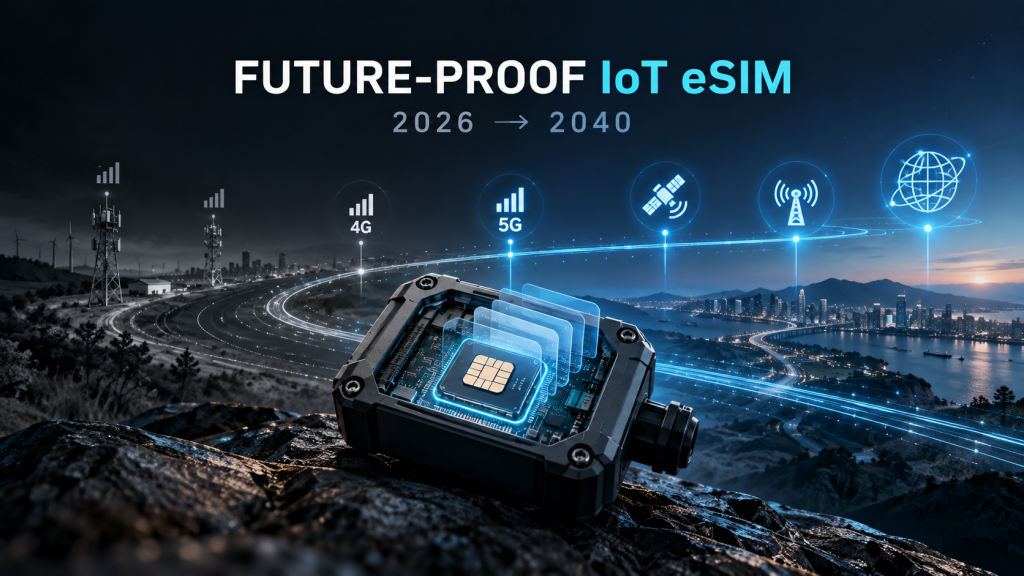
An IoT device specified this year could still be in service in 2040. Over that span the networks it connects to will change, the eSIM standards will move through several versions, and the companies selling connectivity will merge, exit or reinvent themselves. The device has to cope with all of it from a single build. The eUICC sits at the centre of that problem, and it is worth being precise about what it can and cannot protect.
Future-proof IoT eSIM at a glance
- The core issue: devices last 10 to 15 years; networks, standards and suppliers change faster than that.
- What eSIM protects: your choice of operator, including new kinds of operator such as satellite and private networks, provided the radio supports them.
- What eSIM can’t protect: radio technologies the module lacks, non-cellular bearers, and anything fixed into the eUICC at manufacture.
- Frozen at the factory: eUICC operating system and spec (SGP.22 or SGP.32), profile memory, form factor, radio bands.
- Changeable in the field: operational profiles, eIM provider (if contracted for), device and modem firmware (if the update path exists).
- The rule: choose the radio first and the SIM second, and treat every factory-frozen decision as a 15-year commitment.
Three clocks running at different speeds
A long-life IoT deployment runs on three clocks, and they rarely agree.
The device clock is the slowest. Utility meters, EV chargers, building systems and industrial telemetry are commonly specified for 10 to 15 years or more, and the cost of a site visit often exceeds the cost of the hardware. Once installed, the device is effectively permanent.
The network clock runs faster. The UK switched off its 3G networks between 2023 and 2025, and 2G is due to go by 2033. Any device that relied on those layers, and only those layers, became stranded regardless of how good its SIM was. New layers arrive on the same clock: 5G RedCap, satellite non-terrestrial networks (NTN) and private LTE and 5G are all appearing within the lifetime of devices being built now.
The standards clock is the least visible. SGP.32 certification currently tracks v1.2, v1.3 was published in May 2026, and later versions will follow. Suppliers move on the same clock: the eIM platform you choose today may change owner, product or strategy before your devices retire.
The eUICC is where the three clocks meet. It is built on the device clock, it carries profiles that belong to the network clock, and it runs an operating system written to the standards clock. That is why eUICC decisions made at design time matter so much more than the connectivity contract signed at launch.
Frozen at the factory vs changeable in the field
The practical way to future-proof an IoT eSIM design is to sort every connectivity decision into one of two columns, then spend most of your engineering attention on the first.
| Decision | When it’s fixed | Can it change later? |
|---|---|---|
| eUICC spec (SGP.22 or SGP.32) | Manufacture | No. The eUICC operating system can’t be upgraded over the air; moving spec means new hardware or a removable card. |
| Profile memory and simultaneous profiles | Manufacture | No. If there’s no room for a second profile, a clean swap gets harder. |
| Form factor (soldered MFF2 or removable) | Manufacture | No. Removable cards keep a physical upgrade path; soldered parts don’t. |
| Radio technologies and bands | Module selection | No. A profile can’t add a radio the module lacks. |
| IPA location (IPAd in the device, IPAe on the eUICC) | Design | Partly. IPAd lives in firmware the vendor may or may not keep updating; IPAe travels with the card. |
| Modem BIP and STK support | Module firmware | Partly, if the module maker ships updates and you can deploy them. |
| Bootstrap profile | Provisioning | Yes, but only while it can still reach a network to be replaced. |
| Operational profiles | Provisioning | Yes. This is what eSIM was built for. |
| eIM provider | Contract | Yes, if portability was agreed up front. |
What the eUICC can protect
Within its column, the eUICC is a genuinely powerful long-life tool. It protects you against an operator raising prices, losing coverage, being acquired or withdrawing from IoT. It lets a fleet move between networks as commercial terms change, without truck rolls. It allows regional rollouts on local profiles. And it opens the door to operators that barely existed in IoT a few years ago: satellite providers working to 3GPP NTN (introduced for NB-IoT and LTE-M in Release 17), and private LTE and 5G networks at ports, mines, campuses and ships, several of which now issue their own profiles.
That last point is the one most often missed. Over a 15-year life, “changing operator” may well mean adding a completely different type of network rather than swapping one national carrier for another.
What the eUICC can’t protect
The limits are just as important, and they explain most of the stranded devices in the field today.
Radio technology the module doesn’t support. A 2G-only device with the most flexible eUICC in the world still goes dark when 2G does. A module without NTN support can’t use a satellite profile, however easily that profile could be downloaded.
Non-cellular bearers. Wi-Fi, Wi-Fi HaLow, LoRaWAN and wired links sit outside the SIM entirely. If your future connectivity mix includes them, that is a hardware and firmware decision, not an eSIM one.
Anything fixed into the eUICC. The spec, the operating system and the memory are set at manufacture. An SGP.22 eUICC stays SGP.22.
A supplier that disappears. If your eIM provider exits and you never agreed a way to move, you can lose the ability to manage profiles even though the hardware is fine.
The short version: an eUICC changes who your device connects through. It doesn’t change how the radio connects. Future-proofing the second is a module and firmware decision.
Design rules for a 15-year device
None of these are exotic. They are the decisions that are cheap at design time and expensive or impossible afterwards.
- Choose the radio first, the SIM second. Pick a module with a clear path beyond any single layer: LTE-M and NB-IoT where coverage suits, Cat 1 bis or RedCap where it doesn’t, and NTN support if the device may sit beyond terrestrial coverage.
- Specify SGP.32 at build. An SGP.22 part with an SGP.32 roadmap promise is still an SGP.22 part. If native SGP.32 isn’t available yet, plan for a removable card rather than an assumed upgrade.
- Size the profile memory deliberately. Ask how many profiles the eUICC can hold at once. Room for the bootstrap plus at least one operational profile makes a swap far safer.
- Confirm BIP and STK support, and the firmware path. eSIM management depends on the modem passing SIM toolkit and BIP traffic. On Quectel-based kit, for example, these settings can be checked with commands such as
AT+QSTK?andAT+QCFG="bip/auth". Then confirm you can actually deploy module firmware updates in the field. - Write eIM portability into the contract. Agree up front how profiles and control move if you change platform, or if the platform changes owner.
- Choose a bootstrap with long-life coverage. A bootstrap that only works on a layer due for sunset turns into a dead end. Multi-network coverage on a long-lived layer is the safer choice.
- Keep a removable path where you can. A SIM slot that accepts a removable IPAe eUICC decouples the management standard from the hardware refresh cycle, which is valuable when you can’t predict which spec your estate will need in ten years.
- Build over-the-air firmware updates in from day one. Use A/B partitions or an equivalent rollback mechanism, so a bad update doesn’t cost a site visit.
A quick test for any design
Run each candidate design through three questions before sign-off. If the main network layer it uses switched off in 2033, would the device still connect? If the eIM provider exited in 2032, could you still manage its profiles? If SGP.32 moved two versions ahead, would the device still be manageable, or would it need replacing? A design that can answer yes to all three is as future-proof as current eSIM technology allows.
Frequently asked questions
Can an SGP.22 eUICC be upgraded to SGP.32 over the air?
No. The spec is part of the eUICC operating system, which is fixed at manufacture. Moving to SGP.32 means new hardware or, where the device has a slot, a removable SGP.32 card with an IPAe.
Does eSIM protect a device against 2G and 3G switch-off?
Only if the module also supports a technology that survives, such as 4G, LTE-M or NB-IoT. eSIM lets you change operator; it can’t add a radio the module doesn’t have.
Can satellite IoT use an eSIM profile?
Yes, where the provider works to 3GPP NTN standards and issues profiles, and the module supports NTN. Proprietary satellite systems with their own radios sit outside the eSIM model.
Is a soldered MFF2 eUICC or a removable card better for long life?
It’s a trade-off. MFF2 is more robust against vibration, temperature and tampering. A removable card keeps a physical upgrade path when the spec or supplier changes. Many long-life designs choose MFF2 for harsh environments and a slot where field access is realistic.