
Cellular Technology Selection for eUICC IoT Deployments: LTE-M, NB-IoT and When 4G Makes Sense
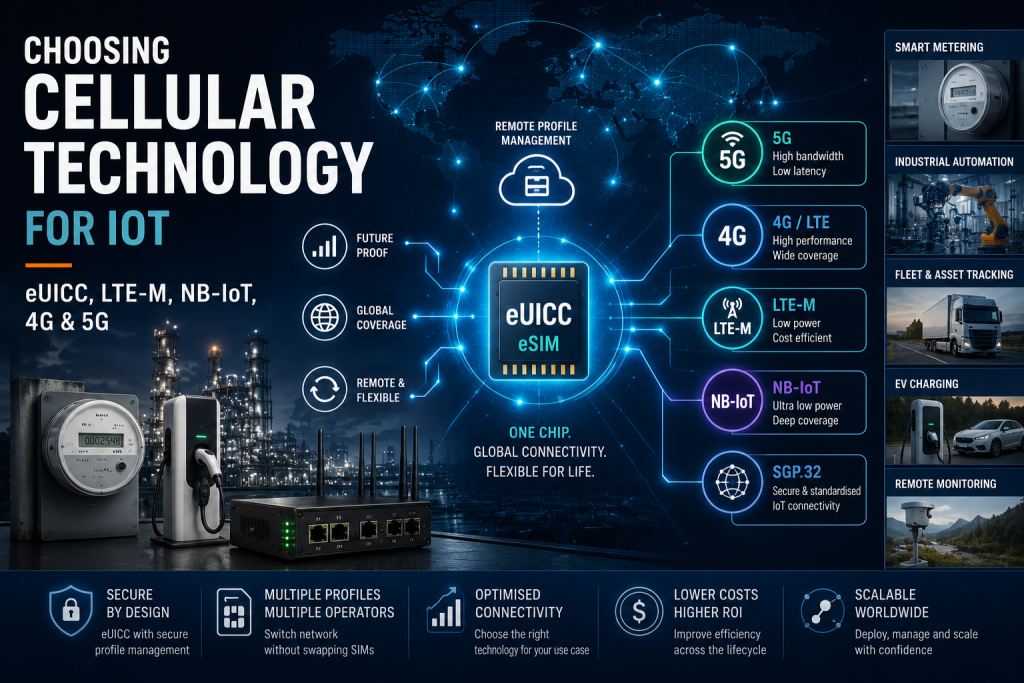
Most of the conversation around eUICC in IoT focuses on the provisioning layer – SGP.32, eIM platforms, remote profile switching, over-the-air activation. That is all important. But there is a decision that sits underneath all of it that tends to get far less attention: which cellular technology should your eUICC device actually use?
It matters more than most buyers realise. An eUICC can switch between operator profiles seamlessly. It cannot switch between radio technologies. The modem inside your device is specified at the point of hardware selection, and it will stay there for the life of the deployment – which in industrial IoT often means a decade or longer. Choosing the wrong technology at that stage does not just affect coverage or battery life. It limits what your eUICC strategy can actually deliver.
This post sets out the practical considerations for cellular technology selection in eUICC IoT deployments: when LTE-M is the right call, when NB-IoT makes more sense, and when 4G LTE is unavoidable regardless of the power implications.
Cellular Technology at a Glance – eUICC IoT Deployments
| Parameter | LTE-M (Cat-M1) | NB-IoT (Cat-NB) | 4G LTE |
|---|---|---|---|
| Typical Speed | 200 kbps – 1 Mbps | 20-60 kbps | 5-30 Mbps |
| Battery Life | Years (PSM / eDRX) Excellent |
Decade+ possible Outstanding |
Mains preferred Limited |
| Signal Penetration | Deep indoor / underground Excellent |
Basement / vault capable Outstanding |
Good at sub-1 GHz Good |
| Mobility | Full handover support Yes |
Static devices only No |
Full support Yes |
| Latency | 100-150 ms | 1.6-10 seconds | 30-50 ms |
| SGP.32 Support | Native – optimised for constrained devices Ideal |
Native – queued profile ops Ideal |
SGP.02 / SGP.22 more appropriate Indirect |
| Profile Downloads | Fast enough to be seamless | Slow – plan as scheduled event | Fast |
| Best For | Asset tracking, mobile sensors, cross-border eSIM roaming | Smart metering, static sensors, deep-site monitoring | SCADA, video, broadband failover, persistent sessions |
Need the full specification breakdown? IoT Portal’s cellular technology comparison covers all five generations – 2G, 4G, 5G, LTE-M and NB-IoT – across speed, power, latency, UK coverage and real-world application examples.
View Full Comparison →Why cellular technology and eUICC are more connected than they appear
The GSMA’s SGP.32 specification – the standard that defines eUICC for IoT – was designed explicitly with constrained devices in mind. That means devices on NB-IoT and LTE-M networks, operating with limited power budgets, minimal processing headroom, and potentially years between maintenance visits.
SGP.32 handles this by allowing the eIM (eSIM IoT Manager) to push profile operations to devices without requiring them to maintain a persistent connection. Devices can wake from PSM or eDRX sleep, receive queued instructions, act on them, and return to sleep. This is a fundamental shift from the earlier SGP.02 M2M standard, which assumed a more capable, always-on device.
The practical implication: if your device is on LTE-M or NB-IoT, SGP.32 is specifically built for it. If your device is on 4G LTE Cat 1 or higher, SGP.02 or consumer eSIM (SGP.22) may be more appropriate depending on the use case.
Cellular technology selection and eUICC standard selection are linked decisions. They should be made together.
LTE-M: the practical default for most eUICC IoT deployments
LTE-M (Cat-M1) is the cellular technology that hits the most useful middle ground for a wide range of IoT deployments. It is worth understanding why.
Throughput sits at 200-400 kbps typical, up to 1 Mbps. That is enough for periodic telemetry, occasional firmware updates, alert messaging, and moderate data bursts – the vast majority of industrial IoT traffic patterns. It is not enough for video or high-frequency data streams, but most IoT deployments do not need those.
Power consumption is genuinely low. PSM and eDRX support allow LTE-M devices to operate for years on battery packs when transmission intervals are managed sensibly. A device reporting hourly on a decent-sized battery is a realistic multi-year deployment without external power.
What distinguishes LTE-M from NB-IoT for eUICC purposes is mobility support and voice. LTE-M supports handover between cells, which means it works properly on moving assets – vehicles, containers, portable equipment. It also supports VoLTE, which matters for alarm panels and some industrial applications where voice-grade communication is required over the same SIM.
For eUICC specifically, LTE-M’s ability to handle profile download operations more quickly than NB-IoT is a practical advantage. Profile operations are not tiny – a full profile download is typically 50-100 kB. On NB-IoT at 20-60 kbps that takes time and consumes power during a period when the device cannot sleep. On LTE-M it is fast enough to be operationally irrelevant.
LTE-M suits eUICC deployments where: the device moves or may need to move, you need occasional higher data bursts, profile operations need to be reliable and reasonably fast, or you need to cover multiple countries with a single roaming eSIM profile that switches to local operators on arrival.
NB-IoT: when battery life and building penetration are the overriding factors
NB-IoT (Cat-NB1/NB2) makes a different set of trade-offs. Throughput is lower – 20-60 kbps typical – and latency is measured in seconds rather than milliseconds. It is not suited to regular large data transfers or anything requiring near-real-time response.
What NB-IoT does exceptionally well is operate in difficult environments on minimal power. The 164 dB maximum coupling loss – 20 dB more than standard LTE – translates directly into coverage in basements, utility chambers, thick-walled industrial buildings, and rural locations where LTE-M would struggle. PSM and eDRX on NB-IoT are even more aggressive than LTE-M, with standby currents that allow decade-long battery life on small primary cells.
For eUICC deployments, NB-IoT is appropriate where the device is static, transmits small payloads infrequently, and sits in a location where signal penetration is a real concern. Smart metering is the textbook example – a meter in a pavement chamber, transmitting a daily reading, expected to run for ten years without a site visit. eUICC with SGP.32 fits this pattern precisely: headless activation, remote profile switching if the operator needs to change, no truck roll required for SIM management.
The constraint to be aware of: profile operations on NB-IoT need to be treated as deliberate, scheduled events rather than background tasks. Some eIM platforms handle this better than others. If you are specifying NB-IoT with SGP.32, verify that your chosen eIM is designed for constrained network behaviour – queued operations, retry logic, and awareness that the device may not be reachable for hours at a time.
NB-IoT suits eUICC deployments where: the device is permanently static, payload sizes are small and infrequent, the installation environment has challenging signal conditions, and decade-scale battery life is a genuine requirement rather than a nice-to-have.
When 4G LTE is the right choice despite the power cost
There are deployments where LTE-M and NB-IoT simply are not appropriate, and 4G LTE is the correct choice regardless of its higher power draw.
Video surveillance and monitoring applications need consistent throughput that LPWAN cannot deliver. A cellular router on a construction site, a CCTV gateway at a remote substation, a vehicle dashcam unit – these need 4G.
SCADA and industrial control applications running DNP3, Modbus TCP, or similar protocols over a persistent connection need low latency and reliable session stability. LTE-M’s 100-150 ms latency is workable but marginal for some control applications; 4G at 30-50 ms is more comfortable.
High-frequency telemetry – vibration analysis, power quality monitoring, applications generating kilobytes of data per second rather than per hour – needs 4G throughput.
For these deployments, eUICC still makes sense, but the relevant standards shift. A 4G cellular router with an eUICC and SGP.02 or consumer eSIM (SGP.22) is appropriate. The profile management model is different – less optimised for constrained behaviour – but the device has mains power and a capable radio so the constraints that motivated SGP.32 do not apply.
eUICC on 4G devices provides the same operational benefits it provides everywhere else: no physical SIM swap for operator changes, MNO diversity across dual-SIM configurations, a single hardware SKU deployable across different regions with profile activation after installation.
Making the technology decision: a practical framework
The three questions that drive the choice are:
How much data does the device transmit, and how often? Under 1 kB per day suggests NB-IoT. Regular bursts up to a few hundred kB with hours between transmissions points to LTE-M. Anything requiring sustained throughput or persistent sessions needs 4G.
Does the device move? If yes, LTE-M or 4G. NB-IoT is designed for static deployments and handles mobility poorly.
What is the power source? Mains-powered opens up 4G. Battery-only makes LTE-M or NB-IoT the only credible options for anything beyond a year or two of operation.
For a detailed technical comparison across all five cellular generations – covering data speeds, frequency bands, power efficiency, signal penetration, latency, and UK network availability – the cellular technology comparison guide at IoT Portal covers the full specification picture in one place: Cellular Technology Comparison for IoT
That guide is a useful reference when writing hardware specifications or evaluating modem options for a new deployment.
The integration point: eUICC does not change the physics
It is worth being direct about one thing. eUICC gives you flexibility over which operator network your device connects to. It does not change the radio technology the modem supports, the frequency bands it can use, or the physics of signal propagation.
A well-specified eUICC deployment on LTE-M – with SGP.32 profile management, a capable eIM platform, and MNO diversity built in – gives you connectivity resilience that was genuinely difficult to achieve five years ago. You can switch operators remotely if coverage degrades, activate local profiles in new markets without touching the device, and manage SIM lifecycle across thousands of devices from a central platform.
But none of that works if the cellular technology was selected wrong at the hardware stage. The eUICC layer sits on top of the radio layer. Get the radio right first.
Peter Green writes about eUICC, SGP.32, and industrial IoT connectivity. More on cellular technology selection and eSIM deployment at euicc.co.uk.