
What is an eUICC? The Chip That Makes IoT eSIM Possible
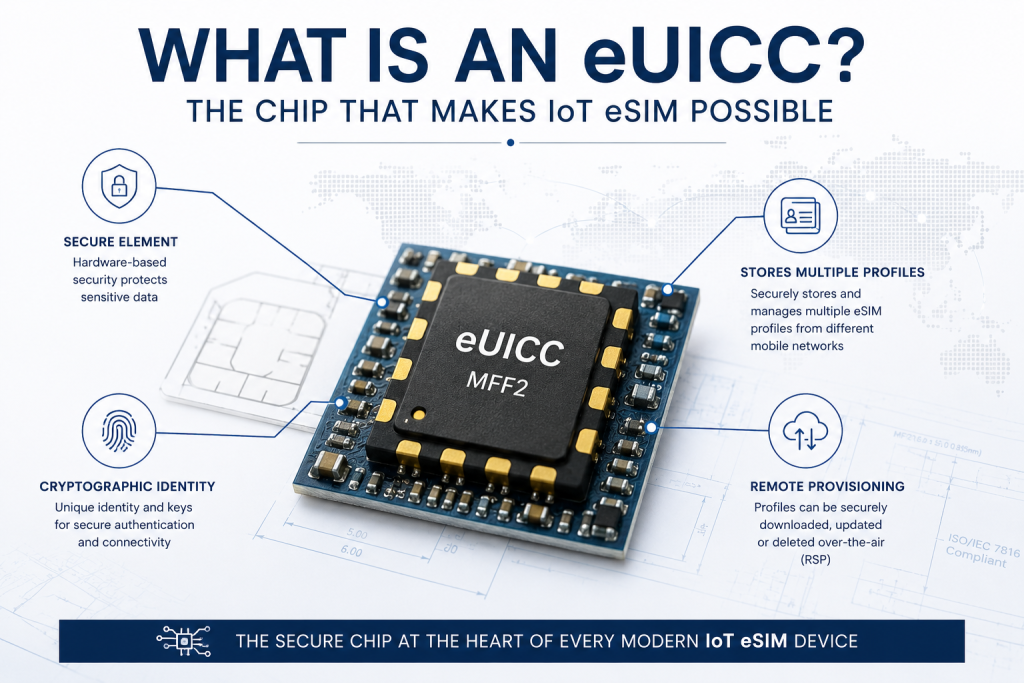
If you have spent any time reading about eSIM, you will have noticed that people use the words “eSIM” and “eUICC” almost interchangeably. They are not the same thing, and the difference matters more than the marketing suggests.
An eSIM is the idea: a SIM you can reprogram over the air instead of swapping a plastic card. The eUICC is the actual piece of hardware that makes that idea work. Everything else, the operator profiles, the remote provisioning, the standards with the SGP numbers, ultimately depends on this one component doing its job inside the device.
This article explains what an eUICC is, how it differs from a traditional SIM, and why it sits at the centre of the entire IoT eSIM story.
What does eUICC stand for?
eUICC stands for embedded Universal Integrated Circuit Card. The UICC part is the same secure element that has lived inside SIM cards for years. The “embedded” prefix signals the important change: the chip is designed to be soldered permanently into a device rather than slotted in and out.
But being soldered down is not the interesting bit. Plenty of ordinary SIMs are supplied in solderable form factors. What makes an eUICC an eUICC is that it can hold multiple operator profiles and switch between them remotely, without anyone touching the device.
That single capability, remote reprogramming, is what separates an eUICC from every SIM that came before it.
eUICC vs eSIM vs SIM: clearing up the terminology
The words get muddled constantly, so it is worth being precise.
- SIM / UICC – the traditional secure element that holds a single operator profile, usually fixed for the life of the card.
- eSIM – the general concept of a remotely reprogrammable SIM. It describes a capability, not a specific chip.
- eUICC – the actual hardware that delivers that capability. When a device is described as “eSIM capable”, it is the eUICC inside that makes it so.
If you want a fuller breakdown of the naming, see our guide to eUICC vs eSIM vs SIM. The short version: eSIM is the promise, the eUICC is the hardware that keeps it.
What makes an eUICC different from a normal SIM?
A traditional SIM is provisioned once. The operator’s profile is written at the factory, and that is the network the SIM belongs to for good. To change networks, you physically replace the card.
An eUICC works differently in three important ways.
It can store multiple profiles. An eUICC can hold several operator profiles at once, with one active at a time. This is the basis of multi-operator and multi-region connectivity.
It can be reprogrammed remotely. New profiles can be downloaded, enabled, disabled or deleted over the air, using a process called remote SIM provisioning. No site visit, no card swap.
It follows a defined lifecycle. Each profile moves through states such as installed, enabled and disabled, all managed through a standardised set of commands rather than an operator’s private tooling.
Put together, these turn the SIM from a fixed component into a manageable, updatable part of the device.
Profiles: what actually lives on an eUICC
A profile is the operator-specific data that a traditional SIM would normally hold: the network credentials, the keys, the identifiers that let a device attach to a mobile network. On an eUICC, a profile is a downloadable package rather than something burned in at manufacture.
That is the conceptual leap. Instead of the operator identity being baked into the chip, the chip becomes a secure container that can receive, hold and swap operator identities on demand. You can read more about how these are structured in our overview of eSIM profiles.
Where the eUICC sits in the IoT eSIM architecture
The eUICC does not operate alone. In the IoT eSIM model defined by the GSMA, it works alongside several other components:
- the eIM (eSIM IoT Remote Manager), which orchestrates profile changes across a fleet of devices
- the IPA (IoT Profile Assistant), which sits on or near the device and handles the local side of provisioning
- the SM-DP+, the server that prepares and delivers operator profiles
The eUICC is the endpoint for all of this. The eIM decides what should happen, the IPA carries the request to the device, the SM-DP+ supplies the profile, and the eUICC is where that profile is securely installed and activated.
The rules governing how these pieces fit together live in the GSMA’s IoT eSIM specifications, SGP.31 and SGP.32. If you want the full picture of how the architecture and the technical implementation relate, we have covered that in detail over on sgp32.co.uk: What is SGP.31 and how does it relate to SGP.32?. For this article, the key point is simpler: the eUICC is the component all of those standards ultimately exist to serve.
Why the eUICC matters so much for IoT
In a smartphone, the eUICC has an easy life. There is a screen, a user, a QR code to scan and a person to tap “download”. If something goes wrong, someone is holding the device.
IoT is the opposite. Devices are frequently:
- unattended, with no screen and no user
- deployed in awkward or remote locations
- running on constrained networks such as NB-IoT or LTE-M
- expected to stay in the field for a decade or more
In that world, the ability to reprogram the SIM remotely is not a convenience, it is essential. Sending an engineer to swap a card in ten thousand devices scattered across a country is not a plan, it is a budget disaster. The eUICC is what makes lifetime connectivity management possible without ever touching the hardware again.
Consumer eUICC versus IoT eUICC
The eUICC hardware is broadly the same idea in both worlds, but the way it is managed differs sharply.
Consumer eSIM, governed by the GSMA’s SGP.22 specification, assumes a user is present to drive the process. IoT eSIM, governed by SGP.31 and SGP.32, assumes nobody is there at all and hands control to the eIM instead. Same chip family, very different operating model.
This is exactly why the industry needed a separate IoT standard rather than stretching the consumer one to fit. We explain that split, and why it exists, in the SGP.31 and SGP.32 guide on sgp32.co.uk.
What to look for when evaluating eUICCs
Most people specifying a product will never read a GSMA specification, and they do not need to. But a few practical questions are worth asking a supplier:
- Which standards does it support? For IoT, you want an eUICC aligned with SGP.31 and SGP.32, not only the consumer SGP.22 model.
- How many profiles can it hold? This determines how many networks or regions you can pre-load or switch between.
- What form factor is it? Options range from removable cards to soldered MFF2 chips and integrated designs.
- How is it managed? Check that the eUICC works with the eIM and provisioning platform you intend to use.
Get those four right and the underlying standards largely take care of themselves.
Frequently Asked Questions
Is an eUICC the same as an eSIM?
Not quite. eSIM is the concept of a remotely reprogrammable SIM. The eUICC is the physical secure element that delivers it. Every eSIM-capable device contains an eUICC.
Can an eUICC hold more than one network?
Yes. Holding multiple operator profiles and switching between them is one of the defining features of an eUICC, though only one profile is active at any given time.
Does an eUICC have to be soldered in?
No. eUICCs come in several form factors, including removable cards. The defining feature is remote reprogrammability, not whether the chip is soldered down.
Which standards apply to IoT eUICCs?
For IoT, the relevant GSMA specifications are SGP.31 and SGP.32, with SGP.33 covering conformance testing. Consumer devices use SGP.22 instead.
Final thoughts
Strip away the acronyms and the eUICC is simple to describe: it is the reprogrammable secure chip that turns a fixed SIM into a manageable one. Every clever thing the IoT eSIM ecosystem does, remote provisioning, multi-operator switching, decade-long deployments, rests on that single component.
The standards define the rules, the eIM and SM-DP+ do the orchestration, but it is the eUICC in the device that makes it real. Understand the chip, and the rest of the ecosystem stops looking like alphabet soup and starts making sense.
WordPress tags: eUICC, eSIM, IoT eSIM, remote SIM provisioning, RSP, eSIM profiles, SGP.31, SGP.32, SGP.22, eIM, IPA, SM-DP+, MFF2, NB-IoT, LTE-M, GSMA, IoT connectivity