
What Is an eSIM? How It Works, Benefits, and Device Compatibility
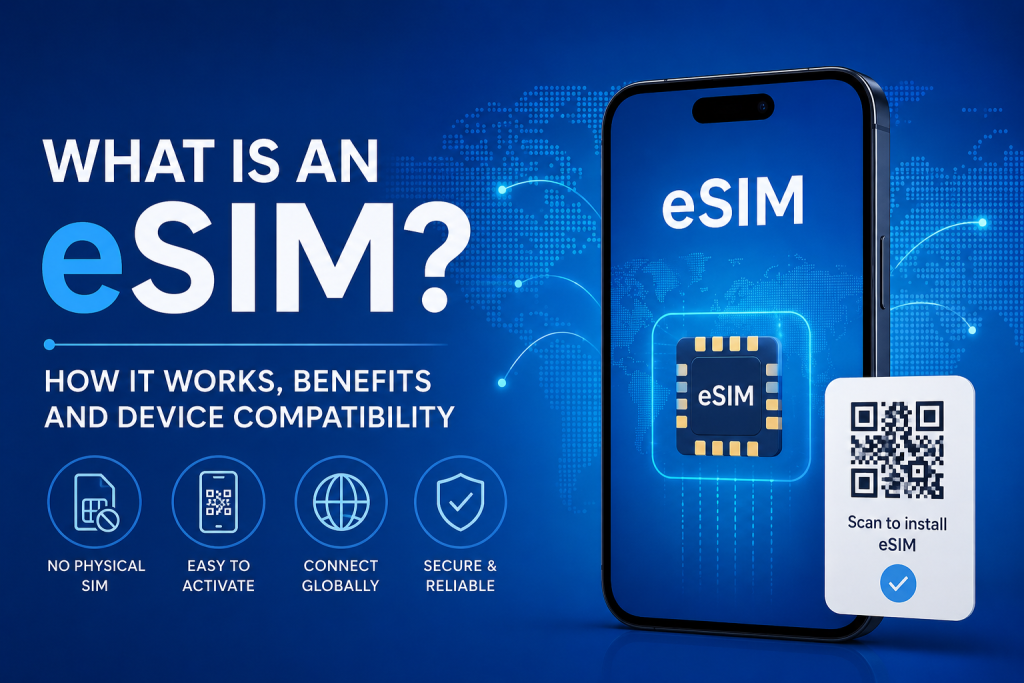
An eSIM, short for embedded SIM, is a digital SIM card built directly into a device’s motherboard. Instead of inserting a physical plastic card, you download your mobile network’s plan straight onto the device, which makes switching carriers or staying connected while travelling far simpler than swapping nano-SIMs in and out.
It sounds like a small change. In practice it’s the foundation a lot of what we build at euicc.co.uk sits on, because eSIM is what makes remote provisioning, multi-profile devices, and IoT fleets manageable at scale.
How eSIM Works
Digital setup. Your mobile provider sends an activation code or QR code. Scan it, and the plan is active within minutes, no courier, no waiting for a card to arrive.
Multi-profile storage. An eSIM chip can store multiple profiles at once. That means a personal line and a work line can sit active on the same device, or separate country profiles for frequent travel, all without physically touching the hardware.
Dual SIM convenience. Most modern phones let you run a physical SIM alongside an eSIM, or two eSIMs at once. For business users juggling a UK number and a travel data plan, that’s the whole point.
Top Benefits of eSIM
Built for travel. You can buy and install a local data plan before you’ve even boarded, which sidesteps the eye-watering roaming charges that catch people out the moment they land.
No swapping required. No popping open a SIM tray with a pin, no losing a nano-SIM down the back of a hotel desk. The profile lives on the device.
Better security. Because the eSIM is built into the device rather than sitting in a removable tray, a thief can’t just pull the SIM out to stop you tracking a lost or stolen phone.
Device Compatibility
Most current smartphones support eSIM, including iPhone XR/XS and newer, Samsung Galaxy S20 and newer, and Google Pixel devices. Some flagship phones in certain markets have dropped the physical SIM tray entirely and now ship eSIM-only.
It’s not just phones. eSIM (and increasingly eUICC, the standard that allows remote SIM profile swapping without physical access) is becoming the default in IoT deployments too, where devices are often sealed, remote, or deployed in volumes that make physical SIM swaps impractical.
eSIM vs eUICC: What’s the Difference?
eSIM refers to the embedded hardware, the chip itself. eUICC (embedded Universal Integrated Circuit Card) is the standard that governs how profiles get written to and swapped on that chip remotely, without anyone touching the device. Every eUICC is an eSIM, but not every eSIM supports the full eUICC remote provisioning standard, which matters a great deal once you’re managing IoT fleets rather than a single handset. We go into this distinction in more depth in our guide to the SGP.32 standard, which is the specification now driving eSIM in IoT.
Frequently Asked Questions
What is the downside of eSIM? The main drawbacks are that switching devices is less straightforward than physically moving a SIM card, since you typically need to deactivate and re-download the profile, and not every device or network supports it yet. There’s also no easy way to lend your SIM to someone else’s phone the way you could with a physical card.
Does an eSIM give you a phone number? Yes. An eSIM works exactly like a physical SIM in terms of service: it connects to a network and is assigned a phone number, calls, texts, and data all work as normal.
What is the point of having an eSIM? Convenience and flexibility. You can switch networks or add a travel plan without ordering a new physical card, run multiple numbers on one device, and avoid the security risk of a SIM that can be physically removed.
Can older or budget devices use eSIM? Not always. eSIM support depends on hardware, so check your specific device model before assuming it’s supported. Most flagship phones from the last few years support it, but budget and older models often don’t.
Looking for the IoT side of eSIM? Our guide to SGP.32 and remote SIM provisioning covers how eUICC profile management works for connected devices at scale.