
The Most Underestimated Chip in the World
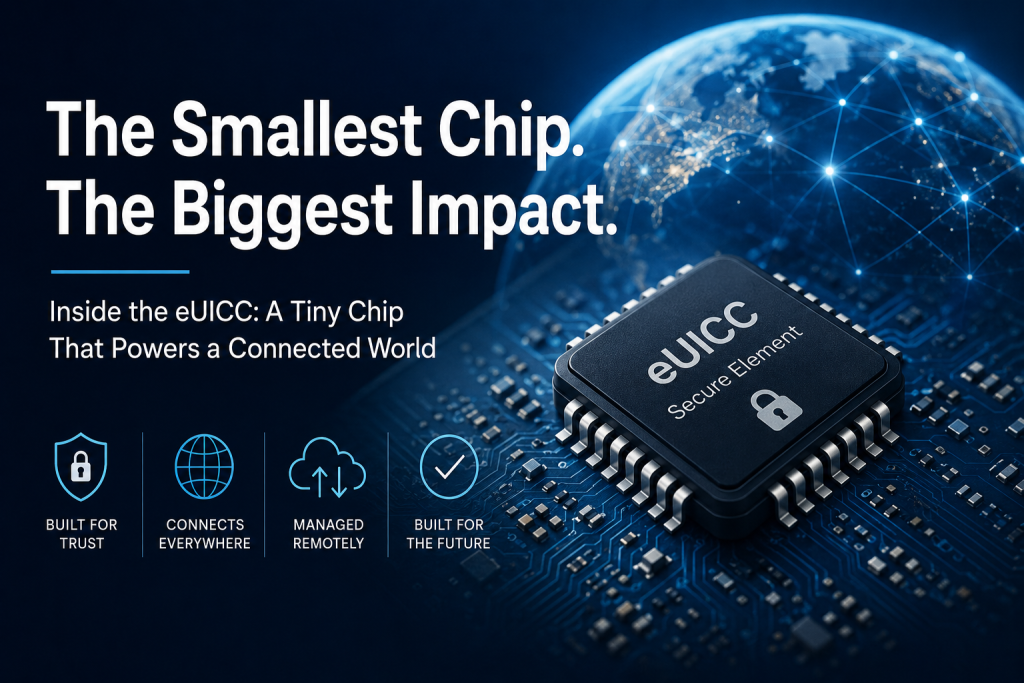
In 1969, a 32-kilogram computer running at 2MHz guided three astronauts to the Moon and back. It had 4KB of RAM, consumed 55 watts, and occupied roughly the same volume as a large briefcase. It is, rightly, considered one of the greatest engineering achievements in human history.
The SIM card in a typical IoT device today matches that raw processing power. It weighs less than a gram. It costs pennies.
Nobody makes documentaries about SIM cards.
The telecoms industry probably owes them one.
Let’s start with what we have right now
Before the history, before the standards, before the acronyms – take a moment to appreciate what a modern eUICC SIM actually is.
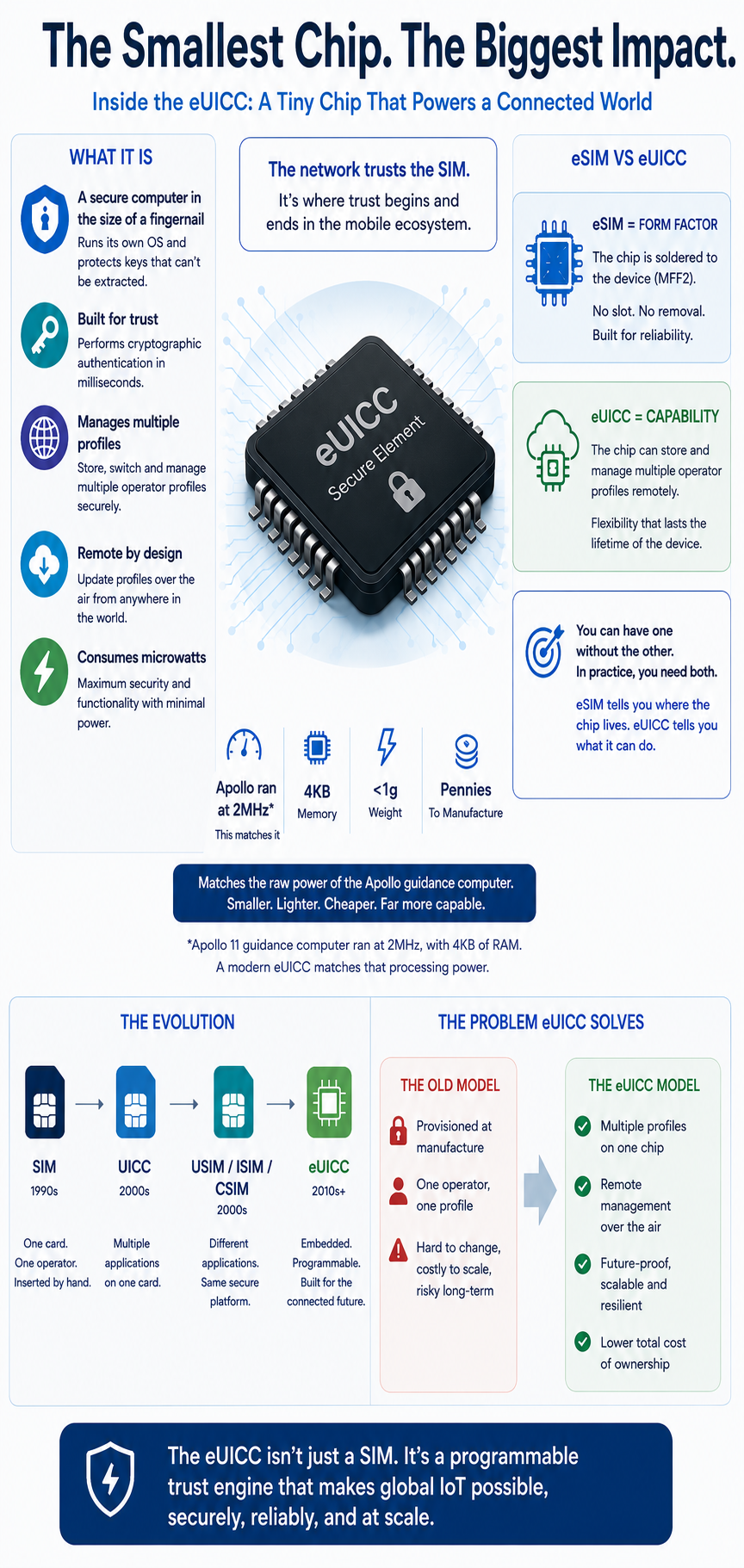
It is a self-contained secure computer small enough to sit on your fingertip. It runs its own operating system. It stores cryptographic keys that are physically impossible to extract – keys the device it lives inside cannot read, keys that no software attack can reach, keys that exist in a hardened secure element designed specifically to resist tampering at every level from software to physical probe.
It performs authentication calculations in milliseconds, silently, every single time a device connects to a network. It manages multiple operator profiles simultaneously. It can receive, install, enable, disable, and delete those profiles over the air – from anywhere in the world – without anyone touching the hardware. It does all of this while consuming microwatts of power.
It does all of this in something roughly the size of a small fingernail.
“The SIM isn’t a memory card. It’s a vault with a processor. The industry just forgot to say so.”
The network does not trust your device. It does not trust your application. It does not trust your firmware. It trusts the SIM. Everything in the mobile ecosystem – every authenticated connection, every billable session, every piece of network access control – flows from that trust. The SIM is where it starts and where it ends.
Understanding that is not academic. It is the foundation for understanding why eUICC exists, why it matters, and why getting it wrong in an IoT deployment has consequences that can take years to surface.
What SIM actually stands for – and why the name undersells it
SIM stands for Subscriber Identity Module. Three words that describe exactly one thing the chip does – identify a subscriber to a network – while saying nothing about how it does it or what else it is capable of.
The name was chosen in the early 1990s when the primary job of the chip was precisely that: hold a unique identifier, authenticate to a network, let a person make a call. At the time, that was sufficient. The name stuck. The chip kept evolving. The name did not.
UICC – Universal Integrated Circuit Card – came later, as the underlying standard expanded beyond the original SIM function to support multiple applications on the same chip. USIM, ISIM, CSIM – different application profiles, same physical card. The UICC became the hardware platform. The SIM became one application running on it.
Then came eUICC. The E stands for Embedded – but that single letter represents a fundamental rethinking of how the chip operates, who controls it, and what it can do across its operational lifetime.
“They called it a Subscriber Identity Module. What they built, eventually, was a programmable trust engine.”
The embedded SIM – form factor versus function
One of the most persistent points of confusion in the industry is the relationship between eSIM and eUICC. They are related but not the same thing, and conflating them causes real problems in procurement conversations.
An eSIM is a form factor. Specifically, it is a SIM that is soldered directly to a circuit board rather than inserted into a removable slot. The MFF2 – Machine Form Factor 2 – is the industrial standard: a small, hardened chip permanently fixed to the PCB, rated for extended temperature ranges, resistant to vibration and moisture ingress. No slot means no slot failure. No removable card means no card falling out in the field. For industrial and IoT applications, that physical permanence is a significant operational advantage in its own right.
eUICC is a software capability. It is the ability to hold multiple operator profiles on the same chip and manage them remotely. It can, in principle, run on any SIM form factor – a standard removable SIM, an MFF2 eSIM, or the newer iSIM where the SIM function is integrated directly into the device’s main System on Chip.
The important point: you can have an eSIM without eUICC – a chip that is physically soldered in place but still locked to a single operator profile. And you can, technically, have eUICC on a removable SIM. In practice, the two almost always travel together, because the use case that justifies one usually demands the other. An industrial device that you cannot physically access is also one where you need remote profile management.
“eSIM tells you where the chip lives. eUICC tells you what it can do. You want both.”
The architecture problem that eUICC solves
Traditional SIM cards operate under the UICC standard and are provisioned at manufacture. One card. One operator. One profile. That model made sense when the primary use case was a human being in a shop, choosing a network, inserting a SIM, and replacing their handset every two years.
It makes very little sense when the use case is ten thousand industrial sensors deployed across three continents, expected to operate for fifteen years, on networks that may consolidate, fail commercially, or simply not exist in the same form by the time the hardware reaches end of life.
The eUICC addresses this at the architecture level. The chip holds multiple operator profiles simultaneously, under a standardised security framework governed by the GSMA. Profiles can be added, switched, enabled, disabled, or deleted remotely without physical intervention.
That is not incremental improvement. It is a different model entirely.
The GSMA’s SGP.02 standard formalised this for M2M deployments. SGP.32 – the more recent evolution – takes it further, designed for constrained IoT devices that cannot support a full Local Profile Assistant stack. Between them, they cover the vast majority of real-world deployment scenarios. These are not marketing constructs. They exist because the industry hit genuine, costly operational walls with the legacy model and needed a coordinated way through them.
“eUICC didn’t make the SIM smarter. It made the SIM free.”
What changes when you deploy it properly
Global logistics simplify immediately. A manufacturer building hardware for multiple markets no longer needs to manage operator-specific SIM variants per region. One SKU ships everywhere. The correct operator profile is provisioned remotely after the device is installed and powered on. The supply chain complexity and the associated error rate disappear at a stroke.
Network resilience becomes a software problem rather than a hardware one. A device holding profiles from two or more operators can fail over automatically when coverage degrades. In critical infrastructure – energy, utilities, transport, industrial monitoring – this is not a preference. It is a specification requirement. eUICC is how you meet it without embedding a physical SIM swap into your maintenance schedule.
The dead SIM problem goes away. One of the quiet, underreported costs of traditional IoT deployments is the device in the field, locked to an operator with degraded local coverage, unreachable, requiring a physical intervention that nobody budgeted for. eUICC turns that hardware problem into a remote software command.
Operational longevity extends meaningfully. IoT hardware does not turn over on a two-year cycle. Devices deployed today may still be running in 2040. Locking those devices to an operator relationship that exists today – with commercial terms that exist today, on infrastructure that exists today – is a liability that compounds quietly until it becomes a crisis. eUICC removes that lock-in at the point of manufacture.
Security posture improves across the stack. Every profile is bound cryptographically to the chip’s unique identity. Profiles are encrypted in transit between the operator’s SM-DP+ server, through the SM-SR, down to the ISD-R on the chip itself. There is no point in that chain where a profile can be intercepted and replicated. In a threat environment where connected devices are increasingly targeted, that architecture is not optional.
“You can harden the application layer all you like. If the SIM is compromised, you have already lost.”
A brief history of the chip nobody noticed
It is worth, briefly, going back to the beginning – because the distance the SIM has travelled makes where it is now all the more remarkable.
The first SIM card was developed in 1991 by Munich smart card maker Giesecke and Devrient, who sold the first 300 units to Finnish operator Radiolinja. It was a full-size card – the 1FF form factor – the same dimensions as a credit card. It did one thing: store a subscriber identity so a GSM network could authenticate a caller.
Through the 1990s the form factor shrank. The mini-SIM – 2FF – became the standard most people recognise. Storage grew slightly. The operating system became marginally more capable. But the fundamental model remained unchanged: one card, one operator, provisioned at manufacture.
The first major architectural shift came with the UICC standard in the early 2000s, which turned the card into a proper multi-application platform. The same physical chip could now run a USIM for 3G authentication, an ISIM for IMS services, and additional applications alongside them. The hardware was becoming a platform. The thinking was not quite keeping pace.
The nano-SIM arrived in 2012 – a 4FF form factor driven largely by Apple’s desire to reclaim internal device space. Smaller again. Same basic model.
The MFF2 eSIM form factor formalised what M2M operators had been doing informally for years: soldering the chip to the board. Industrial applications demanded it. Removable cards and harsh environments do not coexist well.
Then, in 2016, the GSMA published SGP.02 – the M2M eUICC specification. The locked profile model was formally broken. Remote provisioning became a standardised capability rather than a proprietary workaround.
SGP.22 followed for consumer devices. And SGP.32 – published in 2023 – addressed the gap that both earlier standards left: the vast universe of constrained IoT devices that need remote profile management but cannot run the software stack that consumer eSIM requires.
In thirty years, the SIM went from a credit-card-sized piece of plastic that stored a phone number to a hardened, programmable, remotely managed secure element capable of outlasting the commercial relationships it was provisioned with.
“Thirty years. Credit card to fingernail. Single profile to programmable trust engine. The SIM had the quietest revolution in the history of consumer electronics.”
Why any of this matters to you
If you are deploying connected devices – at any scale, in any vertical – the SIM is not a commodity line item in your BOM. It is a strategic component that will determine your operational flexibility, your security posture, and your total cost of ownership across the life of the deployment.
The wrong SIM architecture locks you to an operator, a coverage footprint, and a commercial arrangement at the moment of manufacture. The right one gives you options – options you may not need today but will almost certainly need before the hardware reaches end of life.
eUICC.co.uk exists because those decisions deserve better information than a sales brochure. The standards, the architecture, the real-world deployment considerations – they are all here, written for people who need to understand the technology, not just buy it.
Start with the fundamentals. The rest follows.